Created Thursday, Nov 18th 2021 19:21Z, last updated Thursday, Nov 18th 2021 19:21Z
An ANA All Nippon Airways Boeing 737-800, registration JA64AN performing flight
NH-430 from Fukuoka to Osaka Itami (Japan) with 26 passengers, was enroute at FL270 about 60mn west of Kochi (Japan) when the aircraft encountered turbulence causing injuries to a flight attendant. The aircraft subsequently climbed to FL290 and continued to Osaka for a safe landing about 40 minutes later.
Japan's Ministry of Transport reported the flight attendant received a fracture of the pelvis. At the time of the turbulence encounter the fasten seat belt sign was not illuminated. The JTSB dispatched two investigators on site.
On Nov 18th 2021 the JTSB released their final report concluding the probable cause of the accident was:
It is probable that this accident occurred when the Aircraft shook during the flight in the clouds accompanied by the disturbance, and thereby one of the cabin crew members, who was not seated and floated in the air, was struck on the floor losing his or her balance, and sustained the injury.
The JTSB analysed:
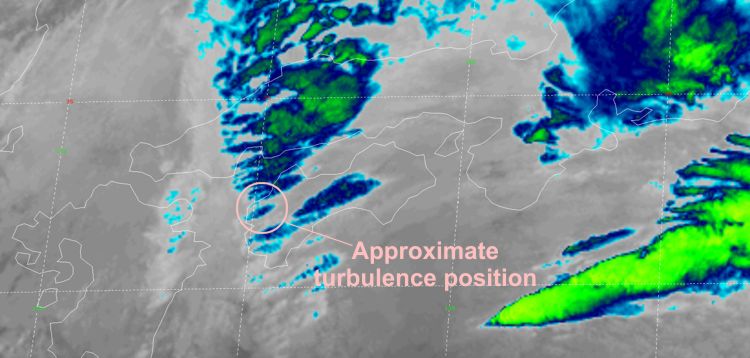
From the CVR records and Meteorological Satellite Images, the clouds accompanied by the disturbance and developed to the altitude close to the cruising altitude are most likely to have existed in the flight route in the vicinity of the location where the Aircraft was shaken. However, it is probable that such strong echoes as ones from which flight crew members could predict the disturbance with the airborne weather radar were not observed because the Radar composite maps did not observe strongly developed echoes in the vicinity of the accident location.
(2) Shaking of the Aircraft
The FDR recorded that the vertical acceleration fluctuated between +1.85 G and -0.30 G for approximately eight seconds from 19:29:40. The Aircraft is more likely to have temporarily been flying in the clouds during this period and have fiercely shaken by the disturbance generated by convective activity in the clouds.
(3) Meteorological judgements by flight crew members
As the Aircraft was in the night flight at dark night when the accident occurred, which requires that judgments on the meteorological conditions be made by the visibility of the stars and lights can be seen in the external monitoring by visual recognition, it is probable that the situations were that detection of the clouds ahead and recognition of the shape of the clouds, etc. were difficult.
(4) Response by a cabin crew member
It is most likely that the Cabin crew member A, who received the negative gravity acceleration, was unable to avoid floating in the air due to the sudden shaking of theAircraft, was struck on the floor losing his or her balance when dropped and sustained the injury.
(5) Securing safety of passengers
When the Aircraft shook fiercely, all 20 passengers were seated and fastened seat belts although seat belt sign was turned off, That is most likely to have contributed to the fact that none of the passengers sustained injuries. This is more likely to have successfully been achieved by the safety measures regularly taken to urge passengers to fasten seat belts anytime while seated.
Infrared Satellite Image Himawari 8 Apr 12th 2020 10:30Z at time of turbulence (Graphics: AVH/JMA):
Related Flight:
NH430, Twitter:
#NH430,
All Nippon Airways News