Created Friday, Sep 9th 2022 19:40Z, last updated Wednesday, Aug 19th 2026 16:18Z
An Air Atlanta Boeing 747-400 freighter, registration TF-AMC performing flight CC-320 from Liege (Belgium) to Malta (Malta), was climbing out of Liege's runway 22L, turned right and overflew Waremme (Belgium) at about 6000-9000 feet at about 23:43L (21:43Z). The aircraft continued to climb to FL330 and landed in Malta without further incident about 2:20 hours later.
The aircraft is still on the ground in Malta about 20 hours after landing in Malta.
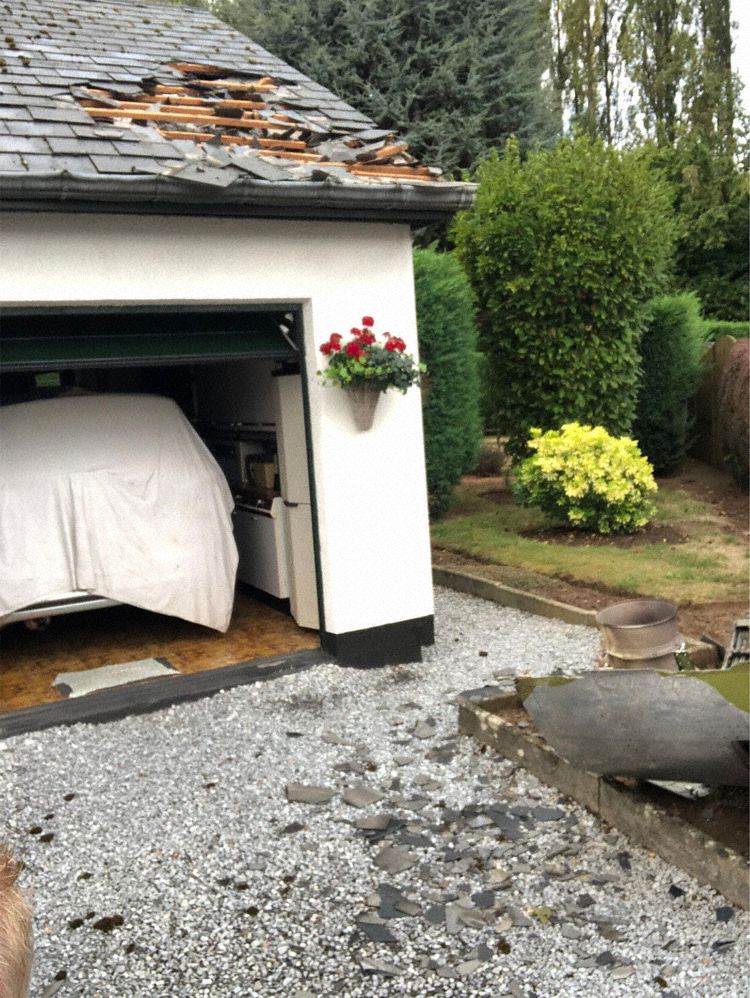
Residents in Waremme were woken by huge noise around midnight (the police reported they perceived the time between 00:30 and 01:00L) and discovered what appeared to be an aircraft part from the engine in their garden, which had impacted and damaged the roof of their house and subsequently fell into their garden.
The Airport of Liege reported an Air Atlanta Boeing 747-400 lost part of aircraft engine cover.
Radar data show a second possible candidate based on the time line given by the residents. TF-AMM performing flight CC-4400 from Liege to Atlanta,GA (USA) was climbing through about 4000 feet over Waremme at 00:37L (22:37Z) and continued to Atlanta, however, was able to continue the flight schedule and departed for the return flight on schedule.
In 2026 Belgium's AAIU released their final report concluding:
The 2 parts of the engine core cowl were inspected by investigators of AAIU. The findings were:
- The RH core cowl, that remained on aircraft, showed minimal damage.
- The LH core cowl that departed from aircraft and fell in Waremme was torn out of its hinges assembly, that remained on aircraft.
- The latching system – 4 independent latches - on both cowls showed minimal wear and damage. All 4 latches were still operational.
- After securing, the 4 latches cannot simultaneously accidentally open.
- When not latched, the latch handle cannot be pushed flush on the cowl.
From the above inspection, it can be concluded that the 2 parts of the engine core cowl were not securely latched prior to the flight.
The incident with Air Atlanta Icelandic is similar in nature with the incidents that occurred in the past, in particular with the A320 series aircraft, however there are important differences:
- The event concerns the engine core cowl, that are less frequently opened than the fan cowl (of the Airbus A320 series).
- On engine No. 4, the latches are located at (more or less) eye level (between 1,4 m and 1,78 m, see Figure 5) and when unsecured, the latch handle is hanging down. There are 4 latches.
This makes the visibility of unsecured latches – at least in daylight condition – much more obvious than the Airbus A320 series fan cowl latches.
In this case, all the elements of the procedural system of the company seem to have being present to avoid such mishap. This includes the knowledge – technical and procedural – of the technicians involved with the maintenance of the aircraft, the clerical confirmation of the tasks, the availability of tooling and documentation.
The maintenance technicians involved in the completion of the tasks were duly qualified, working in the company for several years. They stated they were familiar with the performance of the task, having performed it several times in the past. There was no particular stress or rush to perform the task (it was a busy day, but not overly so), for which all information and tools were available and used. They also stated that, from their recollection of the event, after completion of the works, they had closed and secured the cowls and verified as per procedure.
Before departure, an exterior walk-around, which is a last opportunity and thus a final safety barrier, was performed by the crew, but did not detect the problem. Contributing to this could be that the inspection was made at nighttime in rainy weather, with minimal lighting. The nature of the works was indicated in the technical log, for the information of the crew, however not specifically stating that the engine cowls were open during maintenance.
The damage to the roof:
The part in the garden: