Created Saturday, Jan 8th 2022 08:29Z, last updated Thursday, Apr 10th 2025 15:05Z
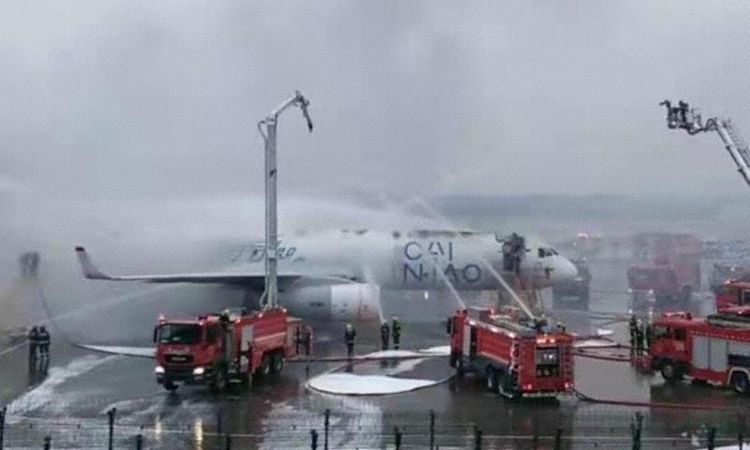
An Aviastar TU Tupolev TU-204, registration RA-64032 performing freight flight 4B-6534 from Hangzhou (China) to Novosibirsk (Russia) with 8 crew and 20 tons of general cargo and 26 tons of fuel, was being pushed back for departure when an open fire started in the cabin. Emergency services responded, upon arrival of emergency services about 2 minutes after the emergency call the fire had already broken through the crown of the aircraft. The crew evacuated safely, the aircraft was damaged beyond repair.
On Apr 10th 2025 the MAK released their final report concluding the probable causes of the accident were:
The investigation team believes that, the initial fire area was inside the console on the right side of the cockpit, and the origin of fire was located behind the audio control panel, in front of the oxygen shut-off and reducing device, and above the regulator control units. The most probable cause of fire is that the crew oxygen system components inside the right-hand console malfunctioned and resulted in oxygen leakage, and then the leaking oxygen formed an ephemeral oxygen-rich environment in the confined space. The considerable heat generated or emitted from the aircraft components and systems in this space ignited the combustible materials in the oxygen-rich environment. The leaking oxygen exacerbated the development and spread of the fire resulting in the substantial damage to the aircraft.
The MAK analysed:
...
Most of the area below the cockpit floor got slightly fire damage, and only the area under theright AOA sensor was severely burned. The severity of the fire damage of the EFIS control panel and audio control panel on the right-hand console was gradually reduced frombottomto top, from back to front and from right to left. The burning loss of the right-side oxygen mask was reduced from bottom to top, and the burning damage of the wander light installed behind the oxygen mask gradually reduced from the bottom up. Among the two burned regulator control units located under the right-side oxygen mask, the front one was more severely damaged. The fire damage on the front side of the oxygen shut-off and reducing device was more severe than that on the rear side. The site survey found that, there were a lot of components burnt in the lower area inside the right-hand console. Part of the thermal insulation layer in that area was burned, and the AOA sensor shell was burned to damage. The position inside the right-hand console, behind the audio control panel, in front of the oxygen shut-off and reducing device, above the regulator control units, presented the most severe fire damage.
The on-duty co-pilot stated in the interview that when he pressed the oxygen test lever on the oxygen mask, he heard a distinct sound of air leakage below the lever, and then a white flash emerged from the left mounting gap of the oxygen mask. This statement indicated that the origin of fire was located under the oxygen mask inside the right-hand console. The on-duty flight engineer stated that, before the fire started, he heard a sound coming from the vicinity of the right-side oxygen equipment, and about 4-5 seconds later, a fleeting crackle came from the same position, followed by a flash. Then a flame ejected upward from the right-hand console approaching the cockpit portable fire extinguisher bottle with a height of about 50cm. This statement indicated that the origin of fire was located inside the right-hand console, and the flame covered the portable fire extinguisher in the cockpit when the fire started. The analysis of CCTV footage showed that, when the flash occurred on the right side of thecockpit, the brightness of the area corresponding to the right-hand side windowwas thehighest. A shadow was formed at the joint structure between the right-side direct vision window and the side window, and a clear shadow was formed on the co-pilot seat. The analysis of the CCTV footage indicated that the light came behind the joint structure and the co-pilot seat. At the initial stage of fire, the intersection of the outline of the fire in the cockpit was located below the corresponding area of the right-hand side window, which was the position of the right-hand console according to the aircraft cockpit layout. According to the site survey, crew interview and CCTV footage analysis, the investigation team concludes that the origin of fire was located inside the right-hand console, behind the audio control panel, in front of the oxygen shut-off and reducing device, and above the regulator control units.
...
The aircraft seen with emergency services fighting the fire: