Created Friday, Dec 3rd 2021 11:40Z, last updated Monday, Mar 27th 2023 18:39Z
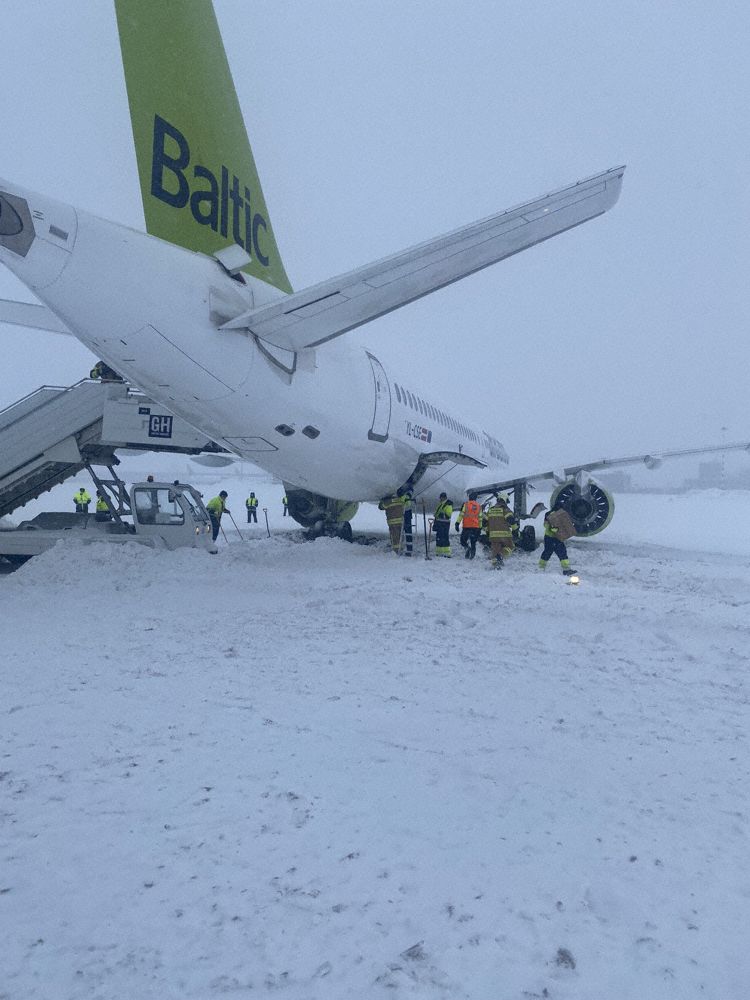
An Air Baltic Bombardier C-Series CS-300, registration YL-CSE performing flight
BT-102 from Stockholm (Sweden) to Riga (Latvia) with 44 people on board, landed on Riga's runway 36 at about 11:55L (09:55Z) when the crew reported they were at the right hand side of the runway about 1700 meters/5600 feet down the runway occupying the runway after they went off the runway while attempting to vacate the runway via a taxiway and became stuck in snow almost perpendicular to the runway. The passengers disembarked via stairs at the left aft main door onto the runway.
The airport confirmed an aviation incident occurred at Riga Airport when the aircraft veered off the taxiway due to poor visibility, the runway needed to be closed.
On Mar 27th 2023 Latvia's TAIIB (Transport Accident and Incident Investigation Bureau) released their final report concluding the probable causes of the serious incident were:
Primary cause
Uncontrolled skidding of the aircraft from the runway surface.
Contributing causes
- Heavy snowfall, crosswind, and low visibility;
- Misunderstanding in the exchange of information about the aircraft braking
action;
- Different interpretation of the runway evaluation by airline pilots and airport services;
- The pilot’s incorrect actions in a non-standard flight situation;
- Lack of the Crew Resource Management (CRM).
Root cause
- Incorrect distribution of priority of the runway cleaning an adverse weather condition in relation to the traffic of aircraft;
- The untimely updating of the situation concerning the runway surface condition;
- Shortcomings in the airline training program regarding the actions of pilots in non-standard flight situations.
Proximate cause
- Insufficient control of the airport responsible services for updating the situation concerning the runway surface condition;
- Inappropriate aircraft handling technique on landing during the ground roll out stage.
The TAIIB analysed:
Weather limitations and conditions
The TOWER ATC issued landing clearance and up-to date meteorological information to the flight BTI1M2: “Wind 270 degrees 8 kt, RVR 1100 meters, heavy snow, RWY36 cleared to land, QNH 993”. Until the flight BTI1M2 landing the surface wind for the RWY36 did not change significantly and the ATC did not give wind check any more.
According to the RIGA-ATIS, the runway condition code was “2”. The coverage of all three parts of the runway was 100% and the depth of the runway’s wet snow coverage was 8mm and there were snowbanks on the RWY 21 meters to the left and right from the runway centreline. According to the meteorological information about the actual weather conditions at the Riga International Airport, the wind indicated a maximum left crosswind of about 4.6 kts with a headwind of 1.1 kts, when the flight BTI1M2 was over the threshold of the RWY36.
The RIGA-ATIS weather conditions were checked timely and recorded in the electronic Operational Flight Plan (OFP) and the RWY36 was in use due to prevailing wind conditions. The aircraft landing performance was calculated and showed a full compliance with the published aircraft limitations and was within limits for ILS approach in accordance with the Operator’s OM Part A.
Before the serious incident the condition of the runway surface was downgrading due to extremely adverse weather conditions, and the snow removal work was often carried out on the runway, but this was complicated because of intensive aircraft traffic at the Riga airport. At the time of the occurrence the runway surface was covered with compacted snow about 8 mm, which physical properties corresponded to the ICE condition according to the RWYCC runway condition code "1". A slippery runway condition is also confirmed by the anti-skid operation, uneven brake application and wheel blocking recorded by the FDM throughout the braking process.
Despite the slippery runway condition, 6 minutes before the occurrence, at 09.48 the previous scheduled flight BTI1R2 landed without an uneventful at the airport "Riga". It was the aircraft Airbus A220-300 operated by airBaltic. The investigation assumes that the runway condition for the previous flight arriving at 09.48 was possible the same or very similar as for the flight involved in the serious incident.
Analysis of simulated landings on a contaminated runway
During the landing of the flight BTI1M2 at the Riga International Airport it was a heavy snowfall and slippery, that caused a low friction condition on the RWY36. After the touchdown zone the aircraft's reverse was applied and the autobrake function was activated, but after 9 seconds of operation the thrust reverser was disabled, but a second before the aircraft's autobrakes were deactivated by pressing the right brake pedal due to the pilot's attempt to compensate manually the aircraft's minor deviation from the runway centerline to the left.
It is possible that in these meteorological conditions the actions of the pilot of controlling the aircraft during the ground landing roll were hasty, because the simulation of the flight situation on the CAE7000XR simulator showed positive results using correct technique to counteract crosswind and with a longer using of the automatic aircraft control system during the ground landing roll under the maximum conditions set on the simulator: runway surface condition ICE and a crosswind 10 knots.
Note: When the runway surface conditions are uncertain or possibly
slippery and wet, it is important to use all available means of the deceleration, including the full reverse. The thrust reverse and speed brakes should not be deactivated, and the braking force should be maintained until the aircraft was safely decelerated.
The analysis of the simulation results allows to conclude that the pilot’s incorrect actions during the landing of the aircraft may have caused the pilot's inability to maintain directional control of the aircraft.
Evaluation of the runway surface condition
16 minutes before the serious incident the pilot of the flight BTI3G2 reported the TWR ATC about the runway braking action and assessed it as "very poor", that does not correspond to the assessment matrix of the runway condition (RCAM) "poor" or "less than poor" according to the Table II-2-5 of ICAO Doc 9981 (see paragraph 1.18).
Thus, it can be assumed that one of the factors that contributed to the serious incident was possible the disagreement and misunderstanding in the exchange of information about the aircraft braking action between the services of the Riga International Airport and the airBaltic aircraft pilot concerning the assessment of braking action efficiency and due to the unclear wording.
...
Actions of the aircraft flight crew during landing
The RWY36 was in use at the Riga airport due to prevailing wind conditions. The reported visibility was low due to heavy snowfall. The reported RWYCC was 2/2/2 and the wind 280/4kts, left crosswind. The crew calculated the landing performance for the reported weather that showed no evidence of any limitation exceedance defined in the Operator’s OM Part B.
At 09.54 the flight BTI1M2 performed the actual landing on the RWY36 (Landing course 358⁰) and at an appropriate speed. The touchdown was executed within the touchdown zone and on the centerline of the runway. Initially during the landing roll the aircraft deviated slightly right from the centerline, the deviation was compensated by using of a left rudder input. The aircraft returned to the centerline. The left rudder input was kept within approximately 0,2 -1,5 inches until the aircraft deviated noticeably to the left, reaching a maximum distance of 15 meters to the left from the centerline. The inappropriate pilot’s actions were applied to counteract the left crosswind and deviation from the centreline (correct rudder and aileron inputs help to counteract aircraft tendency to turn into the wind). No right rudder pedal was applied to correct the deviation left from the RWY centerline.
At a speed of approximately 52 kts instead of using the right rudder input the left rudder input was increased to approx. 3,5 inches with simultaneously applied right brake (maximum input). An asymmetric brake (right brake) application during this stage possibly contributed to further escalation, a subsequent aircraft side skid and a runway excursion at a maximum heading of 79 degrees.
Unintentional or inappropriate use of sidestick (left aileron deflection from +10 to -20 degrees reflected in FDM) at this point led to left MFS spoiler retraction but the right MFS spoiler remained fully deployed. At this speed aerodynamical forces are minimal but persist, which possibly deteriorate the existing condition.
At this stage the aircraft went completely out of control.
Scrutinizing the CVR data, flight crew conversations during the event and subsequent pilot explanations it is obvious that FO (Pilot non-flight, who occupies the right-hand seat) was aware of the escalating situation but did not take any actions (neither mutual nor handling) or actions were well too late to prevent or to stop the escalation of the situation. According to the flight crew conversation, it is possible to assume that the PIC (pilot flying, pilot occupying the left seat) lost situational awareness at some point and was not aware of the aircraft's position during the ground roll.
The analysis of the flight crew's actions during the landing of the A220-300, registration number YL-CSE, suggests that the pilot's inappropriate handling of the control inputs and excessive application of the aircraft's brakes may have been caused by an increased level of stress (possibly "Tunnel Vision") during operation in adverse conditions.
Related NOTAM:
A2084/21 NOTAMN
Q) EVRR/QMRLC/IV/NBO/A /000/999/5655N02358E005
A) EVRA B) 2112031011 C) 2112031300
E) RWY 18/36 CLSD.
Related Flight:
BT102, Twitter:
#BT102,
Air Baltic News