Created Friday, Sep 17th 2021 16:52Z, last updated Friday, Sep 17th 2021 16:52Z
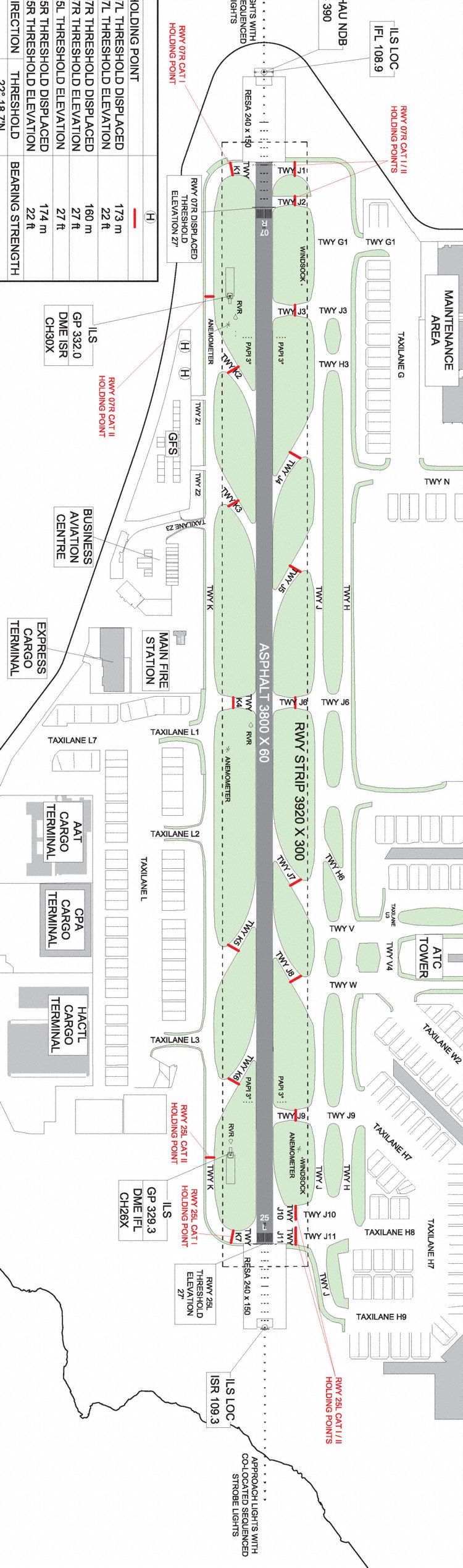
An ACG Air Cargo Global Boeing 747-400 freighter, registration OM-ACB performing freight flight CW-831 from Prague (Czech Republic) to Hong Kong (China) with 4 crew, had landed on Hong Kong's runway 07L and was taxiing towards the cargo apron. The crew reported on ground frequency they were holding short of runway 07R and received clearance to "taxi K, L2 to C12".
A Hong Kong Airlines Airbus A330-300, registration B-LNS performing flight
HX-236 from Hong Kong to Shanghai Pudong (China) with 174 passengers and 13 crew, was cleared for takeoff from runway 07R and was accelerating for takeoff from Hong Kong's runway 07R. About 50 seconds after receiving the takeoff clearance the crew radioed they were rejecting takeoff seeing another aircraft on the runway.
Ground frequency called CW-831 and told the crew that they had not received clearance to cross an active runway, they had just committed a runway incursion, the crew insisted they were cleared to taxi via taxiway K, L2 to C12, the controller repeated they had not received clearance to cross an active runway and they would look into the matter.
Hong Kong's Civil Aviation Department (HKCAD) reported the A330 was about 1000 meters away from the Boeing 747, when they applied brakes and rejected takeoff. The occurrence was rated a serious incident and is being investigated, a high risk of collision existed.
The A330-300, that had left the gate with 25 minutes delay, was able to depart about 20 minutes later and reached Shanghai with a total delay of 40 minutes.
The Boeing departed Hong Kong about 2:20 hours after the occurrence.
On Oct 25th 2017 the Hong Kong CAD released their preliminary report reporting the Boeing 747 after vacating landing runway 07L was cleared to taxi to and hold at holding point J6, which is located short of runway 07R. The A333 was cleared for takeoff from runway 07R, the first officer being pilot flying commenced takeoff, when the 747 was approaching holding point J6 and contacted ground movement control (GMC) for further taxi instructions. GMC issued taxi instructions to taxi from taxiway K to the parking bay at the cargo apron. No runway crossing clearance was issued. However, the 747 continued past the hold short line. When the pilots of the A333 recognized the 747 was entering the runway the captain rejected takeoff, the crew brought the aircraft to a stop abeam taxiway K2, while the B744 continued to cross the runway. Tower instructed the A333 to reject at about the same time the captain rejected takeoff. Preliminary information suggests the minimum distance between the two aircraft was 1100 meters/3600 feet. Visibility was more than 10km and the runway was dry.
The captain of the B744 holds an ATPL and had accumulated 10,408 hours total with 4,296 hours on type.
In August 2021 the AAIA released their final report concluding the probable causes of the serious incident were:
Causes
A taxi instruction without a specific runway crossing clearance was misconstrued to have included a runway crossing clearance and Aircraft 1 entered RWY07R from J6 while Aircraft 2 was commencing take-off on RWY07R. This resulted in a runway incursion.
Contributing Factors
- An instruction for Aircraft 1 to contact AMS for a runway crossing clearance was not effected as a result of probable lapse of concentration.
- Verification of the position of Aircraft 1 was not effected and subsequently an incorrect assumption that the aircraft had already crossed RWY07R was made as a result of loss of situational awareness when instruction was issued.
- Clarification with ATC was not effected before entering an active runway without a specific runway crossing clearance.
The AAIA analysed that a trainee controller under supervision of an instructor was staffing ground control, the instructor took over on several occasions to avoid a ground traffic build up and returned control to the trainee. The trainee then received and handled the occurrence aircraft initially. The AAIA wrote:
Aircraft 1 then reported to GMC “holding short of RWY07R on Taxiway J6”. The instructor took control at this point and gave a taxi instruction to Aircraft 1. The instruction was to taxi via Taxiways K and L2 to parking bay C12.
The Instructor’s Decision to Take Control
Performance of the trainee in response to aircraft requests might have given the instructor an impression that the trainee was not able to maintain a complete and up-to-date mental picture of the developing ground traffic. This probably led to the instructor’s decision to take over. Within the 30 seconds after giving Aircraft 1 the taxi instruction, the instructor consecutively issued three more instructions namely (i) start and pushback approval to the aircraft at North Satellite Concourse, (ii) further taxi clearance to the RWY07L arrival, and (iii) a taxi clearance to another departure aircraft from the south apron. This series of action appeared in line with the instructor’s explanation and had been taken to avoid ground traffic building up.
Instruction Issued to Aircraft 1
The taxi instruction given to Aircraft 1 was “to taxi via K, L2 to parking bay C12”. When Aircraft 1 was on Taxiway J6 holding short of an active runway, the only option for Aircraft 1 to follow the taxi instruction was to cross RWY07R in order to join Taxiway K. A specific runway crossing clearance therefore would be required for Aircraft 1 to cross RWY07R. Although this runway crossing clearance was not issued, the crew of Aircraft 1 misconstrued that the taxi instruction included a runway crossing clearance.
In the investigation interview the instructor admitted not looking out the Tower window or using the A-SMGCS to verify the position of Aircraft 1 before issuing the taxi instruction.
The AAIA analysed further: "Consequently the instructor had a loss of situational awareness and did not realize that Aircraft 1 was only waiting to cross the runway and the required frequency change to AMS had not been given previously."
The AAIA analysed that although the visual alert of the runway incursion alert at the tower's radar screen activated, the aural signal did not sound, which delayed the detection of the runway incursion until after the crew of the A330 reporting rejecting takeoff, at which point the visual alert was noted. The tower controller had been busy coordinating with another ATC unit after issuing the takeoff clearance to the A330. The AAIA wrote the reason for the aural alert not sounding: "Post-incident inspection by technical staff found that the volume settings of the A-SMGCS were turned down and there was no technical issue with the audio function of the system. It was likely that the volume settings had been previously turned down to minimize unwanted alarms generated by the system during scheduled runway closure periods when vehicles would carry out maintenance works on the closed runway and aircraft taxiing or under tow to or from the cargo apron would still need to cross the closed runway. The exact time when the volume settings of the A-SMGCS were turned down could not be ascertained."
Related Flight:
HX236, Twitter:
#HX236,
Hong Kong Airlines News