Created Friday, Nov 25th 2022 19:28Z, last updated Thursday, Feb 13th 2025 18:29Z
A Flair Airlines Boeing 737-800, registration C-FFLC performing flight
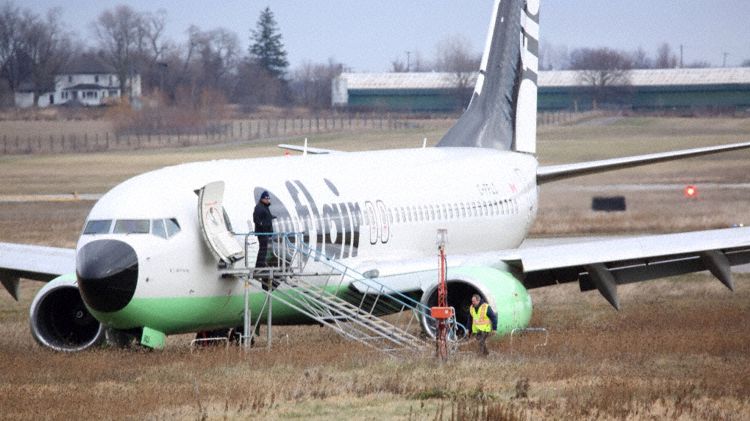
F8-501 (dep Nov 24th) from Vancouver,BC to Kitchener,ON (Canada) with 134 passengers and 6 crew, landed on Kitchener's runway 26 at 06:25L (11:25Z) but overran the end of the runway and came to a stop with all gear on soft ground about 140 meters/470 feet past the runway end. There were no injuries, the aircraft sustained minor if any damage. The passengers disembarked via stairs and were bussed to the terminal.
Canada's TSB have dispatched investigators on site.
On Dec 1st 2022 the TSB reported: "Following touchdown on runway 26 the flight crew encountered some directional control issues, and the aircraft did not decelerate as expected. The aircraft overran the runway, coming to rest approximately 500 feet from the end of runway. There were no injuries, no observed damage to the landing gear, and some minor FOD damage observed on the LH engine. The crew and passengers stayed on the aircraft until airstairs were made available."
On Feb 13th 2025 the TSB released their final report concluding the probable causes of the occurrence were:
- The captain, who was the pilot flying, left the autothrottle engaged after disengaging the autopilot as a result of a habit formed from past flying experience where the practice was permitted.
- The captain had accrued a significant sleep debt in the week before the occurrence and was operating the aircraft after a nearly 18-hour wake period, at the end of a circadian low. As a result, at the time of the occurrence, the captain’s level of fatigue decreased his attention and vigilance and increased the likelihood of a slip.
- Shortly before landing, the captain intended to press the autothrottle disengage switch, but inadvertently pressed the takeoff/go-around switch. This slip likely occurred due in part to the captain’s level of fatigue, and because he was primed to press the takeoff/goaround switch, having mentally rehearsed a go-around earlier in the approach.
- The inadvertent takeoff/go-around selection at 70 feet above ground level occurred during a period on the approach when the flight crew’s primary focus was outside of the flight deck. Therefore, with the indications of the takeoff/go-around selection insufficiently salient to alert the crew, the flight mode annunciator and engine thrust display indications for mode change went unnoticed by the flight crew.
- The left reverse thrust lever had been locked in the stowed position per the minimum equipment list . When selecting the right reverse thrust lever following touchdown, the pilot removed his hand from the forward thrust levers, allowing the left one to advance, undetected, as commanded by the autothrottle.
- Although the aircraft was on the ground and the right thrust reverser was deployed, the autothrottle permitted simultaneous operation of reverse thrust on 1 engine and forward thrust on the other. As a result, the autothrottle continued to command the engines towards go-around thrust until it disengaged automatically when the aircraft slowed below 80 knots.
- The advancing left forward thrust lever caused the speed brakes, which had briefly deployed, to retract and resulted in the deactivation of the auto-braking system, significantly reducing deceleration during the initial ground roll.
- When the captain applied maximum braking, there was 2500 feet of runway remaining, and the aircraft was travelling at a ground speed of 115 knots with no speed brakes, one engine at near maximum thrust, and the other engine nearing maximum reverse thrust. At this speed and in this configuration, there was insufficient runway remaining to stop the aircraft and it overran the end of the runway.
Findings as to risk
- If pilots do not monitor their rest to assess if they have accrued a sleep debt, there is an increased risk of fatigue going undetected and unmitigated.
- If the underlying issue behind a persistent maintenance defect is not addressed in a timely manner, there is a risk that it may compound, resulting in a serious consequence.
Other findings
- Flair Airlines Ltd.’s maintenance, repair, and overhaul tracking system was capable of identifying recurring defects as defined by regulations, but its capabilities did not extend to identifying defects such as the left thrust reverser fault in this occurrence, which did not meet the definition of a recurring defect. The defect had been reported 23 times during the 6 months leading up to the occurrence.
The TSB analysed:
Standard operating procedures
Although the Flair SOP did require the autothrottle to be disengaged at the same time as the autopilot during the occurrence approach, some Flair pilots had been leaving the autothrottle engaged after disengaging the autopilot during approach.
The captain, who was the pilot flying (PF), decided to leave the autothrottle engaged after disengaging the autopilot. This adaptation to the SOPs was likely based on the captain’s previous flying experience with other operators where this was normal procedure. Leaving the autothrottle engaged until a point in the flight when both flight crew members were focused on landing the aircraft made it difficult for each of them to visually confirm whether the autothrottle disengagement had occurred.
Fatigue and priming effect
Fatigue influences performance and cognitive functioning and can lead to errors related to attention and decreased vigilance (slips).
The investigation determined that 4 fatigue risk factors were present at levels sufficient to impact the captain’s cognitive functions. Operating the aircraft after nearly an 18-hour wake period and at the end of a circadian low reduced the captain’s attention and vigilance. The captain’s acute and chronic sleep disruptions from the preceding days exacerbated his fatigue level.
The inadvertent pressing of the takeoff/go-around (TO/GA) switch instead of the autothrottle disengage switch—a slip—is attributed to the detrimental effects of fatigue on the captain’s cognitive functions, making it more challenging for him to remain focused and execute tasks accurately. This inadvertent automatic flight director system mode change went undetected by the flight crew.
Priming occurs when a stimulus in the environment affects a subsequent response by activating mental constructs without conscious realization. When the captain tried to disengage the autothrottle, the go-around procedure, which had been mentally rehearsed earlier on in the approach, likely served to prime his actions.
To mitigate slips and maintain precision and safety in aircraft operations, it is essential to implement a combination of administrative defences, including adherence to standardized procedures, fatigue management, and crew resource management/threat and error management training. Also needed are physical defences, such as ergonomic design considerations with respect to displays and controls within the flight deck, and prominent sensory feedback (aural and visual indicators).
Fitness for duty
In a seniority-based bidding system, a reserve schedule is typically held by pilots with lower seniority because being on reserve is considered less desirable for most pilots.
Being on reserve results in a less predictable schedule, with shorter notice of the planned destinations and length of assignment, and this can make it more difficult for crew members to obtain ideal rest that is tailored to the flights they will be conducting. Pilots are responsible to use their time off or designated rest periods to get the necessary amount of rest to ensure that they are prepared for a duty period, particularly when they are on reserve. Additionally, there is subjectivity involved in determining fitness given that the amount of rest needed varies from person to person.
Aircraft systems
In this occurrence, the inadvertent and undetected autopilot flight director system mode change initiated a complex sequence of events, including an unexpected asymmetric thrust increase, the deactivation of the auto-braking system, and the auto speed brake disengaging after the aircraft landed.
Managing this complexity, especially when the flight crew were primarily focused on maintaining the aircraft's lateral path during landing, became challenging. These issues were exacerbated by the deactivated left thrust reverser. This complexity increased the risk of further confusion, distractions, and errors.
System status and indicators
The displays and feedback indicators related to the autopilot and autothrottle play an important role in a flight crew’s situational awareness. Although these systems share similar purposes and functions, they differ in the way pilots interact with them.
For instance, disengaging the autopilot triggers an audible tone and flashing status light, whereas disengaging the autothrottle does not trigger an audible tone and is only indicated by a status light, making it easier to miss or overlook.
This variation in annunciating between 2 automatic flight systems can be a source of confusion for flight crews and may lead to a reduction in situational awareness with respect to the status of these systems. Relying on the absence of an indicator to confirm system status can be particularly challenging in a high-workload environment.
In addition, the ability that pilots have to override the autothrottle manually with the forward thrust levers without disengaging the autothrottle is not consistent with the way the autopilot system reacts to similar input, where manually overriding using the control wheel results in an autopilot disengagement.
This inconsistency introduces uncertainty into the behaviour of the system, potentially complicating the intended goal of reducing pilot workload. In this case, when the TO/GA switch was unintentionally pressed, the autothrottle attempted to increase engine thrust to go-around thrust. The primary visual indications that this had occurred were the letters “TO/GA” displayed on the flight mode annunciator as the autothrottle engaged mode, along with the flight director cues indicating that pitch attitude must be increased to attain the programmed rate of climb for GA mode.
In situations where the flight crew’s attention is directed outside the flight deck, these indicators might not be sufficiently salient, posing a challenge to maintaining awareness of the system’s status and response.
Single thrust reverser usage
Following touchdown, the PF released both forward thrust levers to grip and actuate the No. 2 (right) reverse thrust lever. Given that the PF was no longer holding the left forward thrust lever at idle, the autothrottle commanded it to move forward towards go-around thrust.
Although it was reported that pilots are trained to keep part of their hand in contact with the forward thrust levers during all reverse thrust operations, this requires an uncomfortable and awkward hand positioning, and the practice does not appear in Flair’s or Boeing’s documentation.
While there are many opportunities during simulator training for pilots to conduct landings with 1 engine inoperative, leading to the use of a single thrust reverser during landing, there is no related guidance in the Flight Crew Operating Manual , and training does not include operating with 1 reverse thrust lever that is locked in the stowed position.
With TO/GA mode selected, many of the conditions that would otherwise cause the autothrottle to disengage automatically were inhibited. There are no autothrottle disengage parameters linked to the use of thrust reversers, in any mode, and as a result it was possible for the autothrottle to command forward thrust while the flight crew was commanding reverse thrust.
The flight crew had set the autobrake switch to 3 and selected auto speed brakes during the approach per company SOPs, and they were expecting the aircraft to automatically decelerate after landing. However, following touchdown, when the autothrottle advanced the left forward thrust lever, these 2 automatic deceleration systems were disabled.
When handling difficulties arose shortly after touchdown because of the asymmetric thrust, the flight crew were occupied with maintaining directional control, and they did not initially realize that the aircraft was not decelerating as expected. By the time maximum manual braking was applied, it was unlikely that the aircraft could have been brought to a stop on the remaining runway available.
Defect control
A defect with the left thrust reverser was first reported in May 2022, more than 6 months before the occurrence. During the intervening months, there were a further 22 reports of a defect with the thrust reverser, each report providing an opportunity to troubleshoot the problem. Despite this, the defect did not meet the regulatory definition of a recurring defect, and as a result, Flair’s maintenance control software did not identify it as such.
A complicating factor is that there were 6 approved maintenance organizations involved in the troubleshooting process, all of which were contracted by Flair to perform maintenance on Flair aircraft. Records show that some of the troubleshooting was duplicated because these AMOs did not have access to the results of previous troubleshooting efforts made by other AMOs.
A simple reset procedure had been used a number of times before the occurrence to clear the fault message and allow the aircraft to continue to be flown, although it was clear that the underlying issue with the system was not being addressed. The initial troubleshooting effort did indicate the likely cause of the issue, but a parts request was not approved for almost 6 months.
Related NOTAMs:
J7848/22 NOTAMN
Q) CZYZ/QMRLC/IV/NBO/A/000/999/4328N08023W005
A) CYKF B) 2211251136 C) 2211251300 EST
E) RWY 08/26 CLSD.
J7850/22 NOTAMR J7848/22
Q) CZYZ/QMRLC/IV/NBO/A/000/999/4328N08023W005
A) CYKF B) 2211251159 C) 2211260500 EST
E) RWY 08/26 CLSD.
J7851/22 NOTAMR J7849/22
Q) CZYZ/QMXLC/IV/M/A/000/999/4328N08023W005
A) CYKF B) 2211251237 C) 2211260500 EST
E) TWY C CLSD SOUTH OF RWY 08/26
A7028/22 NOTAMR A6960/22
Q) CZYZ/QFAXX/IV/NBO/A/000/999/4328N08023W005
A) CYKF B) 2211250511 C) 2211251311
E) RSC 08 5/5/5 100 PCT WET, 100 PCT WET, 100 PCT WET. VALID NOV 25 0502 - NOV 25 1302.
RSC 26 5/5/5 100 PCT WET, 100 PCT WET, 100 PCT WET. VALID NOV 25 0502 - NOV 25 1302.
RSC 14/32 100 PCT WET. VALID NOV 25 0504 - NOV 25 1304.
ADDN NON-GRF/TALPA INFO:
CRFI 08 NR/NR/NR.
CRFI 26 NR/NR/NR.
CRFI 14/32 NR.
RMK: TWY ALL TWYS: WET.
RMK: APN ALL APRONS: WET.
Related Flight:
F8501, Twitter:
#F8501,
Flair Airlines News