Created Thursday, Feb 17th 2022 16:47Z, last updated Wednesday, Apr 3rd 2024 16:03Z
An Air France Airbus A320-200, registration F-HEPB performing flight
AF-605 from Fort de France (Martinique) to Pointe-a-Pitre (Guadeloupe), was on visual approach to Pointe-a-Pitre's runway 12 in a right hand base when the captain lost visual reference of the airport due to a squall. The Minimum Safe Altitude Warning (MSAW) activated. The aircraft initiated a go around from about 450 feet, climbed to 3500 feet, positioned for another approach and landed safely on runway 12 about 20 minutes after the go around.
The French BEA reported the aircraft was on a right hand visual approach to runway 12 when on the base leg the captain lost visual sight of the runway due to a squall passing through. The MSAW activated. Coming out of the turn the aircraft was not aligned with the runway and went around. The French BEA rated the occurrence an incident and opened an investigation.
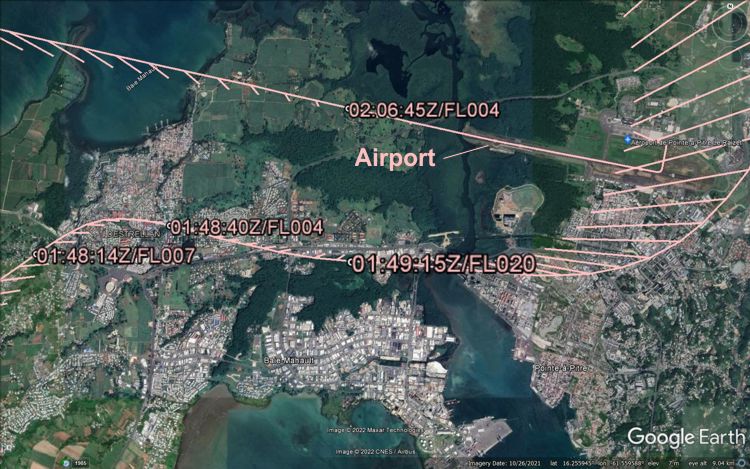
According to ADS-B data the aircraft was descending through 450 feet AGL (reaching a minimum of 425 feet AGL) when the aircraft went around. At that point the aircraft was still about 1nm off the extended runway center line and about 2.15nm from the runway threshold (measured along the extended runway centerline, 2.43nm direct line to the threshold) at a track of 100 degrees over the village of Destrellan.
On Aug 11th 2023 the French BEA released their final report in French only advising the English version will be released soon and concluding the probable cause of the incident were:
Contributing to the choice of a night visual approach under unfavourable weather conditions were:
- a desire to optimize trajectory and flight times
- the crew's desire to maintain non-automated flight training
- the frequent use of these trajectories in this flight sector
Contributing to the failure of the visual approach were:
- the threat, not identified by the approach briefing, posed by the pilot flying's seat position at the left hand for a right hand visual circuit
- underestimation of the risk of encountering low level clouds
- the choice of automatics (A/THR disengaged) resulting in a work load for the crew which in turn degraded both pilots' level of performance.
On Apr 3rd 2024 the BEA released their final report in English concluding the probable causes were:
The following factors contributed to the crew’s decision to follow a night visual approach path in weather conditions that were finally adverse:
- a wish to optimise the path and flight times;
- the crew’s desire to maintain flying skills without using automation;
- the frequent use of these flight paths in this flight sector.
The following factors contributed to the aborted visual approach:
- the threat, not identified during the approach briefing, due to the PF’s position (left seat) for a right-hand circuit;
- the underestimated risk of encountering low-height clouds;
- the decision to use the automation level corresponding to daylight conditions (A/THR switched off), which resulted in a heavy workload for the crew and degraded the performance level of both pilots.
The BEA summarized the scenario:
During the night descent, estimating that the weather conditions were favourable, the pilots requested a visual approach, which the controller cleared.
After starting to prepare the aeroplane, before turning onto the base leg, the PF disconnected the automation, including the A/THR. He asked the PM to “manage speed” in order to have the speed targets calculated by the FMS. The approach phase was not activated. The PM activated the approach phase via the MCDU.
He then carried out the actions associated with the landing gear extension (arming the ground spoilers, switching on the lights, announcing the imminent landing to passengers) before extending the flaps to position 3. Throughout this period, which lasted more than one minute, the PM’s workload did not allow him to monitor the path sufficiently.
Fifteen seconds after switching off the automation, the PF initiated a right turn towards the base leg and then the final. Faced with a few cloud banks and precipitation, the PF lost sight of the runway for a few moments. The initial bank angle of 15° finally increased to 28°. With this bank angle and a north-easterly wind, the aeroplane stayed within the desired path. In addition, the vertical speed increased to -2,000 ft/min. The erroneous path in the vertical and horizontal profiles and the high vertical speed were not detected.
When the controller announced and then repeated the information about the MSAW warning, the crew realised their mistake. They checked their position using the ND and, realising that the aeroplane was not aligned with the runway centreline, they decided to go around. After radar vectoring and an ILS approach, the landing took place without further incident.
Related Flight:
AF605, Twitter:
#AF605,
Air France News