Created Thursday, Nov 18th 2021 19:17Z, last updated Thursday, Nov 18th 2021 19:17Z
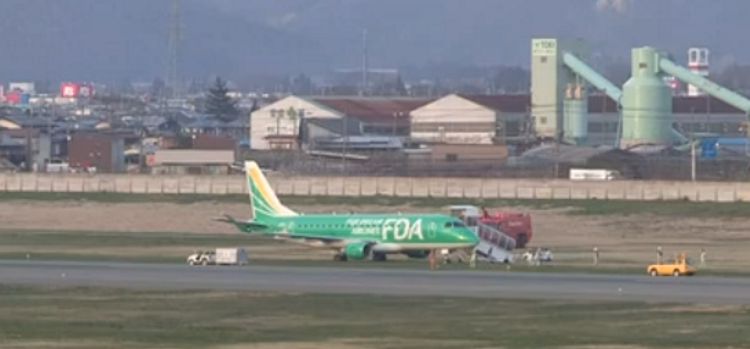
A Fuji Dream Airlines Embraer ERJ-175, registration JA11FJ performing flight
JH-386 from Yamagata to Nagoya (Japan) with 60 passengers and 4 crew, was about to depart Yamagata's runway 19 at about 16:40L (07:40Z) when the aircraft veered left off the runway and came to a stop on the grass at the eastern side of the runway. There were no injuries, the damage to the aircraft is being assessed.
Japan's TSB rated the occurrence a serious incident and opened an investigation.
The airline confirmed the aircraft departed runway 19 and came to a stop on the green zone at the east side of the runway. All passengers disembarked without injuries. The cause of the occurrence is being investigated.
On Nov 18th 2021 the JTSB released their final report concluding the probable cause of the serious incident was:
The JTSB concludes that the probable cause of this serious incident was that because the Aircraft could not change its direction while trying to control the nosewheel steering with the Pedal mode when it started takeoff roll, the Aircraft was disabled to move on its own when it stopped in the grass field after running off the side of the runway while aborting the takeoff.
Regarding the reason why the Pedal mode could not control the nosewheel steering, it is highly probable that because there was an abnormality in the microswitch inside the Handle, the steering mode stayed in the Handle mode.
The cause of the microswitch failure could not be determined even in the detailed investigation.
The JTSB analysed that nose wheel steering is being achieved by either using the steering wheel (+/- 76 degrees of rotation) or the rudder pedals (+/- 7 degrees of rotation). These modes can not be used simultaneously. If the nose wheel steering handle is held down, a microswitch engages the handle mode, when it is being released the rudder mode engages. The QAR recordings showed however, that the microswitch detecting release of the handle remained engaged even after release of the handle, thus disabling nose wheel steering via the rudder pedals. The switch had still worked while the aircraft was taxiing out. The JTSB wrote in their analysis:
When observing the disassembled microswitch by a digital microscope, a very small amount of the metal fine particles and the fibrous material were observed near the contact points.
It is probable that the metal fine particles result from worn contact points inside the microswitch, however, the amount of metal fine particles was too small to determine the reason why the microswitch was in the Handle mode, in addition, it is highly probable that the fibrous material was low in the conductive property as a result of the investigation by a scanning electron microscope, therefore, neither was able to clarify the relationship to the fact that the microswitch had been in the Handle mode.
Related Flight:
JH386, Twitter:
#JH386,
Fuji Dream Airlines News