Created Tuesday, Oct 5th 2021 14:01Z, last updated Friday, Jul 8th 2022 11:02Z
An iAero Boeing 737-800, registration N820TJ performing flight
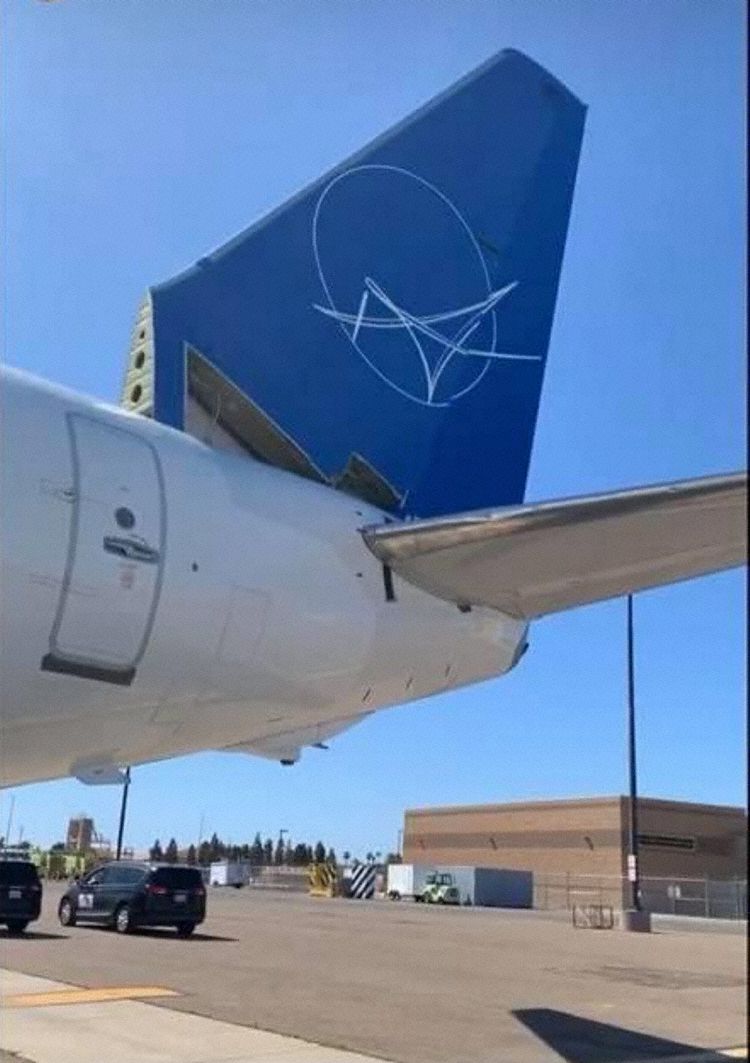
WQ-3518 from Victorville,CA to San Diego,CA (USA) with 88 passengers and 7 crew, departed Victorville's runway 17 and completed the seemingly uneventful flight with a safe landing on San Diego's runway 27 about 41 minutes after departure. Following landing it was discovered parts had come off the vertical tail's leading edge as well as left side in flight.
The aircraft is still on the ground in San Diego about 45 hours after landing.
On May 23rd 2020 the NTSB announced the occurrence occurred at Victorville and was rated an accident and is being investigated by the NTSB stating: "NTSB investigators will use data provided by various entities, including, but not limited to, the Federal Aviation Administration and/or the operator, and will not travel in support of this investigation to prepare this aircraft accident report."
In Oct 2021 the NTSB stated in their preliminary report:
On May 19, 2020, Swift Air flight 3518, a Boeing B737-800, N820TJ, was climbing through about 8,000 feet when the flight crew heard a loud bang but the systems and engine indications remained normal. The flight crew elected to continue to San Diego International Airport (SAN), San Diego, California. Post-flight examination of the airplane found that the vertical stabilizer dorsal fin and several other panels were missing. The left horizontal stabilizer was substantially damaged from impact with the missing components. The flight was operated as a 14 Code of Federal Regulations Part 121 scheduled passenger flight from Victorville Airport (VCV), Victorville, California, to SAN.
On Jul 8th 2022 the NTSB released their final report concluding the probable cause of the accident was:
Improper installation of dorsal fin attach bolts which caused the dorsal fin to separate during flight, substantially damaging the left horizontal stabilizer.
The NTSB analysed:
After departure, the air carrier airplane was climbing through an altitude of about 8,000 ft, at which time the flight crew heard a loud bang. Because the flight instruments and gauges showed nothing abnormal, the flight crew elected to continue the flight to the destination airport. The airplane landed uneventfully. Postflight inspection of the airplane found that the dorsal fin and three panels on the lower left side of the vertical stabilizer were missing, and that the left horizontal stabilizer was substantially damaged.
Most of the dorsal fin, the vertical stabilizer panels, and 7 of the 14 bolts attaching the dorsal fin to the fuselage were not recovered. Of the seven bolts that were recovered, four remined installed, and three were found loose. Three of the four installed bolts remained attached to pieces of the dorsal fin structure. Examination of the photographs showed that the bolts installed in three positions on the left side of the dorsal fin were the correct part number. The bolt installed in a position on the right side of the dorsal fin was not the correct part number, and the bolt was longer than required. The photographs also showed remnants of old sealant at each of the bolt locations but no evidence that sealant was applied during maintenance of the dorsal fin in February 2019 (less than 3 months before the accident).
The seven missing bolts for the dorsal fin structure became loose, had fractured, or were not properly installed.