Created Tuesday, May 4th 2021 14:43Z, last updated Tuesday, May 4th 2021 14:43Z
An Air Inuit de Havilland Dash 8-300, registration C-GXAI performing flight
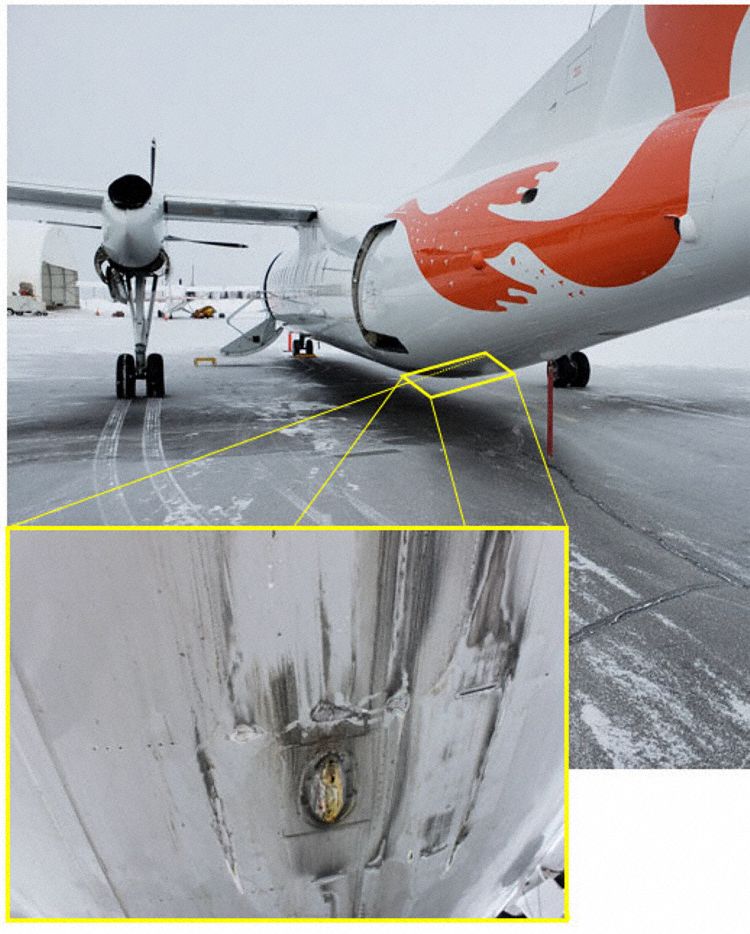
3H-820 from Quebec City,QC to Schefferville,QC (Canada) with 42 passengers and 3 crew, was landing in Schefferville at 11:09L (16:09Z) when the crew received a "TOUCHED RUNWAY" indication. The aircraft rolled out without further incident and taxied to the apron.
The Canadian TSB the aft fuselage contacted the runway surface resulting in damage. The TSB rated the occurrence an accident and opened a Class 3 investigation.
On May 4th 2021 the TSB released their final report concluding the probable causes of the accident were:
Findings as to causes and contributing factors
These are conditions, acts or safety deficiencies that were found to have caused or contributed to this occurrence.
- The pilots forgot to perform the descent checklist and realized this at an inopportune time, when the pilot monitoring was providing a position report.
- Given the ambiguities and contradictions in the stabilized approach guidelines, the captain interpreted that he was allowed to continue the approach below 500 feet above aerodrome elevation although the flaps had not been set to 35° and the final checklist had not been completed.
- Communicating with the flight attendant to confirm the cabin status and performing the descent checklist during final approach added to the pilots’ workload, which was already heavy.
- The combination of the visual conditions and the plan continuation bias prompted the pilots to continue managing the height and speed deviations past the stabilized approach gate.
- When the aircraft passed 500 feet above aerodrome elevation, the pilots, who were dealing with a heavy workload, passed the stabilized approach gate without noticing it and continued the approach, which was de facto unstable.
- At the time of the flare, the aircraft no longer had enough energy to stop the rate of descent solely by increasing the pitch attitude.
- The instinctive reaction to increase the pitch attitude, combined with the hard landing, resulted in the aft fuselage striking the runway, causing major damage to the aircraft’s structure.
Findings as to risk
These are conditions, unsafe acts or safety deficiencies that were found not to be a factor in this occurrence but could have adverse consequences in future occurrences.
- If a procedure is interpreted in a way that limits communications concerning cabin safety, there is a risk that pilots will not be informed that the cabin has not been secured and that passengers will receive injuries on landing, particularly if there is an abnormal landing.
- If there is no reminder of the altitude of the stabilized approach gate for each approach, this stabilized approach gate may be missed, and an unstabilized approach may be continued, increasing the risk of an approach-and-landing accident.
- If Transport Canada Civil Aviation does not assess the quality, consistency, accuracy, conciseness, clarity, relevance, and content of standard operating procedures, the procedures may be ineffective, increasing risks to flight operations.
- If required training elements are not included in recurrent training, there may be procedural deficiencies or deviations, increasing risks to flight operations.
- If Transport Canada Civil Aviation’s surveillance plan does not verify the content of crew training, deviations may not be identified and procedural deficiencies or deviations may not be corrected, increasing risks to flight operations.
- If information that is essential to flight operations for a particular aircraft type are not distributed directly to the operators of that aircraft type, there is a risk that those operators will not have all the resources needed to develop procedures and training that will prevent incidents or accidents.
Other findings
These items could enhance safety, resolve an issue of controversy, or provide a data point for future safety studies.
- Data from the cockpit voice recorder were not secured after the accident, and the accident was not reported to the TSB until the next day. Data from the cockpit voice recorder specific to the accident were nevertheless available to TSB investigators.
The TSB reported the captain (ATPL, 10,186 hours total, 5,024 hours on type) was pilot flying, the first officer (CPL, 1,055 hours total, 83 hours on type) was pilot monitoring.
The TSB summarized the decisive sequence of events:
At 1107:58, while the aircraft was on the base leg approximately 2.45 NM from the runway, the PF noticed that the aircraft was coming in fast and high (162 KIAS and 3100 feet ASL, that is, 480 feet above a nominal 3° slope). He then reduced the engine torque (power) and asked the PM to increase propeller speed to 1050 rpm to help slow down the aircraft. The PM set the propellers to 1050 rpm as the aircraft was turning onto its final approach course, passing through 1000 feet AGL. As the aircraft was turning left, the PF asked the PM to lower the landing gear. The aircraft passed the final approach course by approximately 400 feet to the northeast and then very briefly banked left up to 36°, which triggered a bank angle alert from the terrain awareness and warning system (TAWS).
At 1108:21, as the aircraft was passing through 750 feet AGL, still turning left, a second TAWS alert was triggered, this time by the rate of descent, which had momentarily reached 2500 fpm. The aircraft maintained a speed of 162 KIAS. The PF then corrected the bank angle and stabilized the rate of descent to approximately 1000 fpm, ending the turn to intercept the final approach course.
Once the aircraft was established on the final approach to Runway 35, the PM advised the PF on how to manage the height and speed. After analysis, the PM determined that the approach and landing were feasible, even though the aircraft was flying above the nominal 3° slope at a high speed. The PM then performed the descent checklist while the PF continued to reduce speed as he proceeded with the approach.
At 1108:37, the aircraft descended through 500 feet AGL at a speed of 144 KIAS and decelerating, with flaps at 5°, landing gear extended, power at idle, and propellers set to a speed of 1050 rpm. At that point, the aircraft was 150 feet above the nominal 3° slope. The PF then asked the PM to set the flaps to 15° and perform the landing checklist, which the PM did, as well as sounding a chime twice to notify the flight attendant that landing was imminent.
At 1108:58, as the aircraft reached 200 feet AGL with a rate of descent of approximately 1000 fpm and a speed of 120 KIAS, with a 1.5° nose-up attitude, the PF asked the PM to set the flaps to 35° and the propeller speed to 1200 rpm, and to perform the final checklist. The PM performed the requested actions and completed the final check as the aircraft was passing through 100 feet AGL, at 1109:10.
At that point, the airspeed was 96 KIAS, below the Vref of 99 KIAS, and continuing to decrease rapidly. Power was at idle, the aircraft had a 1° nose-up attitude, and it began to descend rapidly. The PM called out the Vref speed, and immediately afterward, Vref minus 5.
At 1109:13, the aircraft passed through 50 feet AGL at a rate of descent of nearly 900 fpm and a speed of 94 KIAS, with a 2° nose-up attitude. The PM then told the PF to add power, which the PF did, while increasing the nose-up attitude to arrest the descent.
At 1109:16, the aircraft landed hard with a 9° nose-up attitude, during which the lower aft fuselage struck the runway. While taxiing on the runway, the crew noticed that the “Touched Runway” indicator had illuminated.
After landing, the aircraft taxied normally and parked in front of the terminal at 1111.
In accordance with the tail strike checklist, the crew performed an external inspection of the aircraft and contacted Air Inuit’s maintenance department.
The TSB analysed the Approach Execution:
To understand why the approach was continued, the context must be examined, along with the crew’s perception and understanding of the situation as they were making decisions, because situational awareness is an integral part of a pilot’s decision-making process.
Plan continuation bias
The results of Flight Safety Foundation studies show that a pilot’s level of risk perception depends as much on weather conditions as it does on flight parameters. For example, during visual approaches, pilots are more likely to continue an unstabilized approach because they perceive less risk in salvaging the approach.
On the occurrence flight, as the pilots were approaching CYKL, they had to slightly modify their plan because they did not see the airport when they expected to. Once they had the airport in sight, they returned to their initial plan of conducting a visual approach and decided to continue the approach, although the aircraft’s height and speed were higher than planned. From that point on, the pilots focused primarily on their individual tasks and on information—airspeed, rate of descent, and altitude—that they deemed critical to completing this visual approach.
Specifically, the pilot flying (PF) was attempting to reduce the airspeed so that the aircraft could be configured for a landing. The PM was busy completing checklists, ensuring that the cabin was secured for a landing, and advising the PF on how to manage the airspeed.
Furthermore, the PM interrupted his position report when he realized that the descent checklist had not been completed. The PM contacted the flight attendant to ensure that the cabin was secured.
Finding as to causes and contributing factors
Communicating with the flight attendant to confirm the cabin status and performing the descent checklist during final approach added to the pilots’ workload, which was already heavy.
Faced with a heavy workload, pilots tend to use mental shortcuts and take fewer elements into consideration in decision making. They also tend to assess fewer scenarios and underestimate risks.
The decision to continue with the landing can be explained by a combination of confirmation bias and a plan continuation bias. The fact that the PF successfully completed a series of tasks may have reinforced the PM’s impression that they had the situation under control. Since changing a plan requires more effort than sticking with the original plan, and since the captain had little time and few resources available for decision making, the PM and PF gave more weight to the signs that they had the situation under control than to the signs suggesting that they needed to change the plan. This confirmation bias anchored them in a plan continuation bias.
Finding as to causes and contributing factors
The combination of the visual conditions and the plan continuation bias prompted the pilots to continue managing height and speed deviations past the stabilized approach gate.
Managing workload during final approach
The crew felt the heavy workload but was attempting to manage the tasks to be completed.
However, neither of the flight crew members heard the alert from the terrain awareness and warning system (TAWS) at 500 feet AAE, owing to inattentional deafness. A heavy workload leaves few attentional resources available to monitor the environment. Although the aural alert was loud enough to be heard, the pilots did not have sufficient cognitive resources available to enable a mental picture of the alarm to be activated in their memory, and therefore did not perceive the alert.
Air Inuit had a no fault/no blame go-around policy for unstable approaches. However, to facilitate a go-around decision, the crew must be able to identify an unstabilized approach by the stabilized approach gate. According to the SOPs, when the aircraft passed 500 feet AAE, the speed should have been 120 KIAS (with a deviation tolerance of −5 KIAS or +10 KIAS). Furthermore, all checklists, except the final checklist, should have been completed. An analysis of the FDR data determined that, when the aircraft passed the stabilized approach gate (500 feet AAE), its speed was approximately 144 KIAS and decelerating, the flaps had not yet been lowered to 15°, the descent checklist was being performed, and the final checklist had not yet been started.
Finding as to causes and contributing factors
When the aircraft passed 500 feet AAE, the pilots, who were dealing with a heavy workload, passed the stabilized approach gate without noticing it and continued the approach, which was de facto unstable.
The crew was actively managing the situation below 500 feet AAE. The PF succeeded in slowing down the aircraft to the desired speed (Vref), and the final checks were done at 100 feet AAE. Although the aircraft was fully configured and had intercepted the nominal 3° slope, the airspeed was dropping quickly below Vref and the aircraft was losing energy because power was still at idle.
Finding as to causes and contributing factors
At the time of the flare, the aircraft no longer had enough energy to stop the rate of descent solely by increasing the pitch attitude.
The PM noticed the low energy and asked the PF to increase power.
The PF increased power slightly and, at the same time, reacted instinctively with a pronounced pitch-up control input (2 seconds before impact). Similar to the occurrence in investigation report A12Q0161, in this occurrence the PF had not seen the video recommending that aircraft energy be managed by increasing power while limiting the pitch attitude.
The aircraft’s pitch changed from 2° to 9° in less than 2 seconds, and the PM did not have enough time to prevent the hard landing and aft fuselage strike.
Finding as to causes and contributing factors
The instinctive reaction to increase the pitch attitude, combined with the hard landing, resulted in the aft fuselage striking the runway, causing major damage to the aircraft’s structure.