Created Wednesday, May 12th 2021 17:44Z, last updated Tuesday, Apr 4th 2023 14:31Z
A Key Lime Air Swearingen SA-226TC Metro II, registration N280KL performing flight KG-970 from Salida,CO to Denver Centennial,CO (USA) with one crew, was on a visual approach to Centennial's runway 17L cleared for the approach and was descending through 6400 feet about 3nm north of the threshold runway 17L at about 11:24L (16:24Z).
A private Cirrus SR-22, registration N416DJ with two people on board, was cleared for a visual approach to runway 17R and was advised of the traffic landing on the parallel runway. The Cirrus descended through 6400 feet about 3nm north of the threshold of runway 17R, but overshot the centerlines of both runways 17R and 17L.
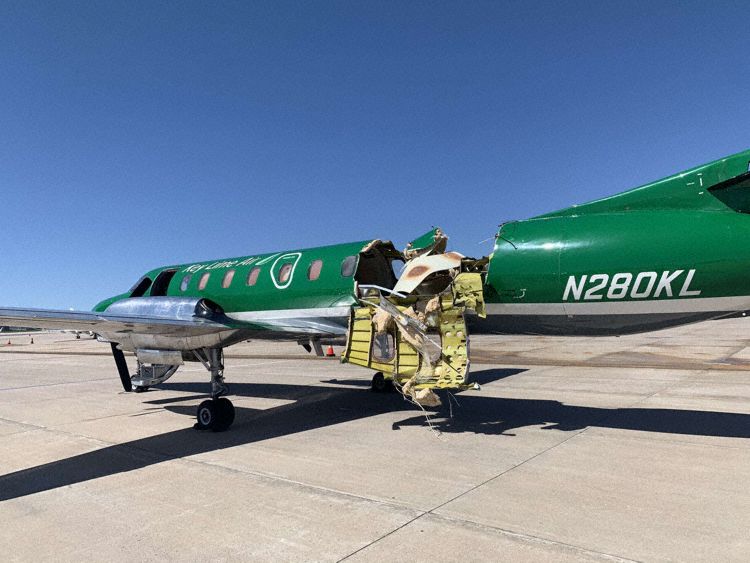
The two aircraft collided, the Cirrus apparently struck across through the fuselage of the Metroliner just above the wings taking out the whole cabin section at that point. The Metro crew declared emergency on tower frequency reporting their right hand engine had failed and reported they saw another aircraft on parachute going down. After landing the crew advised, it had definitely been a mid air collision.
The Cirrus pilot activated their parachute and landed in a field nearby with no injuries. The crew of the Metroliner managed to land the aircraft at Centennial Airport.
The Cirrus with two people on board ended up about 2.7nm north of runway 17L in the area of the Cherry Creek Reservoir. The local Sheriff's Office gave the location of the Cirrus between E. Bellevue Ave and S. Cherry Creek Drive. The Sheriffs Office stated, the other aircraft was carrying cargo only and was flown by a single pilot. There were no injuries.
The NTSB have opened an investigation and are dispatching investigators on site stating: "NTSB is investigating the May 12, 2021, mid-air collision involving a Metroliner & a Cirrus near Denver, Colorado. No injuries reported in connection with the collision. Initial report indicates collision happened as airplanes were landing. The NTSB will travel to the scene."
The NTSB released their final report concluding the probable cause of the accident was:
The Cirrus pilot’s failure to maintain the final approach course for the assigned runway, which resulted in a collision with the Swearingen which was on final approach to the parallel runway.
Contributing to the accident was the failure of the controller to issue a traffic advisory to the Swearingen pilot regarding the location of Cirrus, and the Cirrus pilot’s decision to fly higher than recommended approach speed which resulted in a larger turn radius and contributed to his overshoot of the final approach course.
The NTSB analysed:
A Cirrus SR22 and a Swearingen AS226TC were approaching to land on parallel runways and being controlled by different controllers on different control tower frequencies. The pilot of the Swearingen was established on an extended final approach for the left runway, while the pilot of the Cirrus was flying a right traffic pattern for the right runway.
Data from an on-board recording device showed that the Cirrus’ airspeed on the base leg of the approach was more than 50 kts above the manufacturer’s recommended speed of 90 to 95 kts. As the Cirrus made the right turn from the base leg to the final approach, its flight path carried it through the extended centerline for the assigned runway (right), and into the extended centerline for the left runway where the collision occurred. At the time of the collision, the Cirrus had completed about ½ of the 90° turn from base to final and its trajectory would have taken it even further left of the final approach course for the left runway.
The pilot of the Swearingen landed uneventfully; the pilot of the Cirrus deployed the airframe parachute system, and the airplane came to rest upright about 3 nautical miles from the airport. Both airplanes sustained substantial damage to their fuselage.
During the approach sequence the controller working the Swearingen did not issue a traffic advisory to the pilot regarding the location of the Cirrus and the potential conflict. The issuance of traffic information during simultaneous parallel runway operations was required by Federal Aviation Administration Order JO 7110.65Y, which details air traffic control procedures and phraseology for use by persons providing air traffic control services. The controller working the Cirrus did issue a traffic advisory to the Cirrus pilot regarding the Swearingen on the parallel approach.
Based on the available information, the pilot of the Cirrus utilized a much higher than recommended approach speed which increased the airplane’s radius of turn. The pilot then misjudged the airplane’s flight path, which resulted in the airplane flying through the assigned final approach course and into the path of the parallel runway. The controller did not issue a traffic advisory to the pilot of Swearingen regarding the location of the Cirrus. The two airplanes were on different tower frequencies and had the controller issued an advisory, the pilot of the Swearingen may have been able to identify the conflict and maneuver his airplane to avoid the collision.
Related Flight:
KG970, Twitter:
#KG970,
Key Lime Air News