Created Wednesday, Jul 28th 2021 13:27Z, last updated Wednesday, Mar 30th 2022 18:54Z
A MartinAir Boeing 747-400 freighter, registration PH-CKC performing flight
MP-8561 from Amsterdam (Netherlands) to Nairobi (Kenya), was climbing through FL120 out of Amsterdam when the crew heard some noise. In the absence of any abnormal indications the crew decided to continue the flight to Kenya where the aircraft landed safely about 7:25 hours after departure.
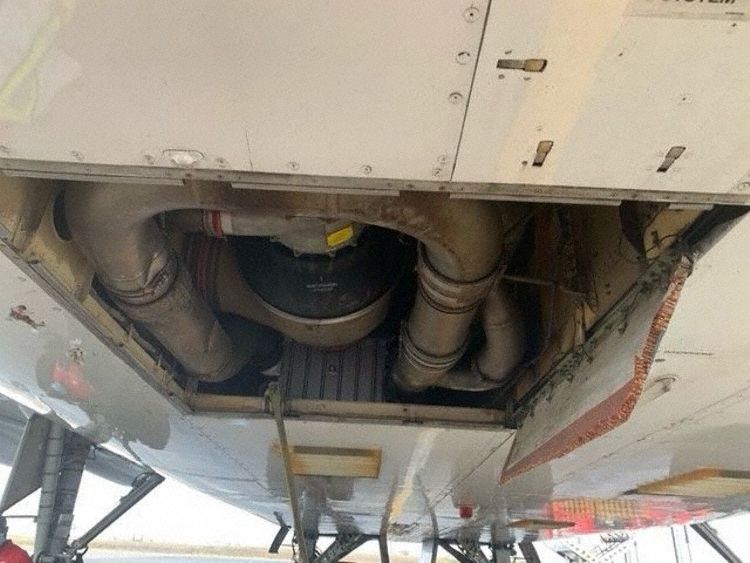
A post flight inspection revealed that a panel had separated from the underside of the fuselage.
The Onderzoeksraad (Dutch Safety Board DSB) reported on Jul 28th 2021 in a more detailed report, that it is being suspected that the panel separated during the climb and was lost over the Netherlands. The occurrence was rated a serious incident and is being investigated.
The aircraft remained on the ground in Nairobi for about 32 hours, then continued the next sector to Johannesburg (South Africa).
Another occurrence involving another MartinAir Boeing 747-400 had happened the same day, see: Incident: Martin B744 near Lisbon on Jan 16th 2021, electrical problem.
The DSB reported in their Q4/2021 Bulletin, that the investigation was not extensive and released their final report in the Bulletin concluding the probable cause of the incident was:
The air conditioning access door partially broke off during flight, most probably because it was not closed properly after maintenance. Interruption and distraction from the normal work routine of closing the door likely contributed to this occurrence.
The DSB summarized the sequence of events:
The Boeing 747 departed around 22.20 hours for a cargo flight from Amsterdam Airport Schiphol (hereafter Schiphol) to Jomo Kenyatta International Airport in Kenya. During the climb to cruising altitude – at around 12,000 feet - the flight crew heard a thump. Thereafter they noticed a low humming sound in the cockpit and the cabin. According to the flight crew, all Engine Indicating and Crew Alerting System (EICAS) indications were normal. After consultation with the airline, the flight crew decided to continue the flight. Upon arrival in Kenya, during a walk around check, it was found that an air conditioning access door on the underside of the aircraft’s fuselage had broken off. Part of the door was still attached to the aircraft by means of the door hinges; the other part of the door was lost. The departing door parts caused minor damage to the aircraft.
Before departure, while the aircraft was standing on the platform, a team of ground engineers performed several maintenance tasks. The team started working on the aircraft two hours after its arrival, which was later than normal. They first performed the daily inspection and the pre-flight inspection. After these inspections they started to repair recorded defects. One of the repair tasks was the change of a turbine bypass valve on air conditioning pack 3, located behind the access door in question. When the assigned engineer to this task opened the door, he assessed it was not possible to finish the work before the scheduled departure time.
The engineer consulted with maintenance control about the shortage of time and it was decided to replace the valve another time and to take the valve on board of the aircraft in case it would be needed at an outstation. As the other two air conditioning packs were functioning, the aircraft could be released according the Minimum Equipment List (MEL) and the flight could be carried out. Thereafter, the engineer started to close the access door of air conditioning pack 3. However, while doing this, he was interrupted by a fellow engineer. As a result the engineer stopped his activity on the door.
As the engineer’s routine to close the air conditioning access door was interrupted, the latches on the aft side of the door probably were left unlocked. The engineer stated that there were a lot of different activities that evening, whereby you regularly change tasks or help colleagues. The engineer indicated that this is a fairly normal characteristic of the work environment of this ground engineering team. He stated that the team was sufficiently staffed to perform the work on the aircraft. The engineer also noted the dark (night time) conditions may have contributed to the fact that the (probably) unlocked latches were not seen by him at a later stage or by his colleagues who performed the pre-departure service just before the aircraft left the platform.
Furthermore, the maintenance organisation performed a technical investigation on the remaining door parts, that showed signs of an overload failure. This type of failure indicates a fast break off and departure of segments of the door. It is likely that the flight crew had noticed this breakage of the door, as they heard a thump-like noise while the aircraft was on the departure from Schiphol. Therefore, it is likely that during the climb, the door opened as it was not entirely latched and the airstream caused the door to break off. The technical condition of the latching mechanism could not be determined, as the latches and other parts of the door were not recovered.
In the past years, the Boeing 747 air conditioning access doors or parts of the doors have departed in flight or became unlatched upon landing. These door departures were primarily caused by improperly secured or worn door latch mechanisms. Therefore, on the 27th of February, 2017, the manufacturer of the aircraft issued a service bulletin31 to provide instructions for the inspection of the air conditioning access doors with latches and the application of warning stickers to the doors. Following this requirements from the service bulletin, the maintenance organisation had inspected the latches for signs of corrosion at the recommended interval times. No repairs were carried out on the specific air conditioning access door and no other technical abnormalities were found during the last maintenance inspection. Therefore, a technical cause for the opening of the door in-flight is seen as unlikely.
The planned time for the inspections and the repair of PH-CKC was reduced because of extended work on another aircraft. When the engineer assessed that the amount of time required to replace the valve was more than had been planned, the replacement of the valve was postponed. From the interviews with engineers and the staff of the operator and maintenance organisation, the impression was given that it is common for these ground engineers to manage their tasks and to coordinate with maintenance control as necessary to get work accomplished. Also voiced was that the engineers perform their work in a frequently changing environment 31 Boeing Commercial Airplanes, SB 747-53-2897. Fuselage - Air Conditioning Access Doors - Inspection of Latches and Application of Warning Stencils, 2017. such as changes of tasks and time available. In all, the working conditions before, during and after the attempt to replace the valve could be considered as normal for this team of ground engineers.