Created Wednesday, Sep 1st 2021 07:40Z, last updated Wednesday, Sep 1st 2021 07:40Z
A Network Aviation Australia Fokker 100 on behalf of Qantas, registration VH-NHY performing flight
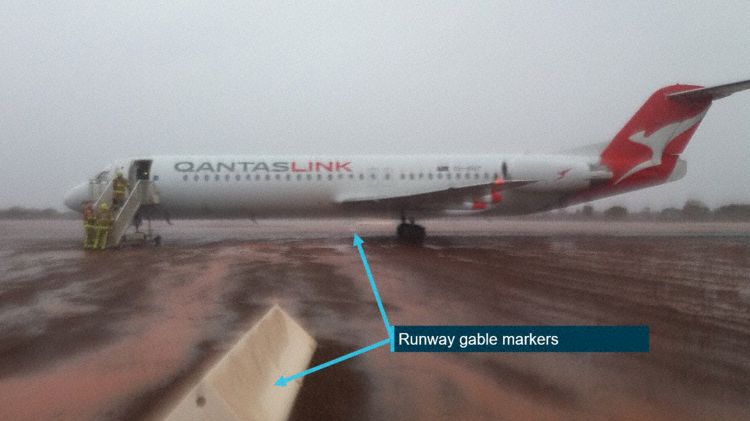
QF-2650 from Perth,WA to Newman,WA (Australia) with 88 passengers and 5 crew, landed on Newman's runway 05 at 07:12L (23:12Z Jan 8th) but overran the end of the runway and came to stop on soft ground (gravel) about 70 meters past the end of the runway. There were no injuries, the aircraft sustained minor damage.
The occurrence aircraft was still on the ground in Newman about 42 hours after landing.
The ATSB have opened a short investigation estimated to finish in quarter 3 of 2020.
On Sep 1st 2021 the ATSB released their final report concluding the probable causes of the incident were:
>Contributing factors
- The combination of the approach speed required by the prevailing wind conditions and the poor braking effectiveness in the wet conditions resulted in the aircraft overrunning the runway.
Other factors that increased risk
- During the flight, the potential for the heavy or moderate rainfall to significantly impact the landing distance was not recognised by the flight crew and therefore not considered as a threat.
- Despite technical examination of the runway identifying areas requiring maintenance to maintain the surface friction, no corrective action was taken.
- The operator's documentation required crew to consider contamination of runways at the departure and destination airports. However, the provided definition and guidance did not include the means to identify water contamination from active rainfall. (Safety Issue)
- CASA advisory publications did not include information regarding the potential for reduction in braking performance resulting from active moderate or heavy rainfall. (Safety Issue)
The captain (5,594 hours total, 1,963 hours on type) was pilot flying, the first officer (2,920 hours total, 182 hours on type) was pilot monitoring.
The ATSB reported: "The aircraft stopped about 70 m beyond the upwind runway threshold, off the runway surface, within the runway end safety area1. There were no injuries and the passengers and crew disembarked via the front stairs and were transported to the terminal. A visual examination of the tyres identified some deep scratches, likely due to the abrasive surface of the runway end safety area. An inspection of the aircraft found that the loose gravel had damaged some of the landing gear components."
The ATSB analysed:
Landing speed, wind conditions and braking performance
The flight crew selected the approach speed based on the known environmental conditions. The selection was a correct application of the guidance for the forecast turbulence, due to the possibility of windshear conditions. The flaps 25 approach along with the additional mandated speed margins, due to the wind conditions, resulted in a higher approach airspeed than for a flaps 42 approach.
The final approach speed was flown as planned however, the aircraft did not slow after crossing the threshold and entering the flare. During this period, a higher groundspeed than airspeed was recorded indicating a possible unforecast tailwind component, which may have limited the ability to reduce the speed. A higher touchdown speed requires a longer stopping distance due to the additional energy to be dissipated by the deceleration devices. As a general rule, a 10 per cent increase in approach speed results in a 20 per cent increase in the required landing distance.
During the landing roll, after the captain (pilot flying) asked for assistance with applying the brakes, it is highly likely that the maximum manual braking effort was being applied. During this same period, the recorded deceleration was low, indicating that the braking effectiveness was reduced. The captain’s report of aquaplaning is consistent with this low deceleration and the directional oscillations recorded during the landing.
The crosswind conditions combined with the aquaplaning increased the difficulty of maintaining directional control. In accordance with the advice in the Aircraft Operating Manual in relation to aquaplaning response, the crew were limited in the amount of reverse thrust that could be applied as the priority was on maintaining the directional stability and keeping the aircraft on the centreline. Without the crosswind, it is likely that the captain could have engaged maximum reverse thrust much earlier in the landing roll, which would have significantly reduced the landing distance.
Given the magnitude of the runway overrun (70 m), it is highly likely that if either the landing speed had been reduced, the braking effectiveness had been normal or there had been less crosswind, the overrun would not have occurred.
Threat identification During the approach briefing, the flight crew correctly identified the primary threat as the significant weather. However, their focus was primarily on the wind and the visibility. Despite the forecast for heavy rain obtained before the flight and the aerodrome weather information service providing observations of heavy rain occurring there was no consideration of the effect of the rainfall on the runway state or the braking performance.
The faster flaps 25 approach was selected to address the identified threat of possible windshear.
However, this selection (compared to the standard flaps 42 approach) further increased the risks associated with reduced runway braking performance. The crosswind was discussed in relation to the selection of the runway but was not identified as possibly affecting the ability of the aircraft to brake effectively or reducing the drainage of water from the runway surface on the windward side.
The approach briefing procedure provided a prompt to discuss the runway state. However, there was no information available to the crew to enable them to identify the potential for a significant reduction in braking performance posed by the active moderate rainfall. As a result, had the crew identified and discussed the threat, the options for them to manage the threat were limited to their own judgement. Therefore, it is possible that even if the flight crew had identified the threat, they would have continued the approach. There was no information reasonably available to the crew to assist them to identify the runway as potentially water contaminated by the active rainfall.
Operator and regulator documentation
Network Aviation policy did not permit operations on contaminated runway however, flight crews were not provided with adequate information to identify all possible runway contaminated situations. At the time of the occurrence, the only information relevant to the conditions on the day within the operator’s document suite was advisory information in relation to heavy rain being a possible contaminant of the runway. There were no specific procedures to identify the rainfall intensity or relating to conducting approaches during active precipitation.
The United States Federal Aviation Administration (FAA) safety alert for flight operators (SAFO) provided a practical means to assess the potential for runway contaminations based solely on the type of runway surface (grooved or ungrooved) and the rain intensity at landing. Using the FAA document and guidance on rainfall intensity it would have been possible for the crew to determine that there was a potential for poor braking performance and take some mitigating action.
At the time of the occurrence, the lack of Civil Aviation Safety Authority (CASA) advisory information reflecting the FAA alert regarding the potential effect of active moderate or heavy rainfall on braking performance, reduced the likelihood that the operator would have the appropriate guidance for mitigating this hazard.
Runway condition
The flight crew and the aerodrome reporting officer (ARO) reported moderate rain at the time of the landing. The lack of grooving on the runway reduced the ability of water to drain from the runway surface. The FAA SAFO advised that moderate rain on an ungrooved runway can cause a significant reduction in braking performance. The heavy rain prior to the final approach and the ARO’s observations in relation to the water accumulation around the runway meant that drainage of water from the runway may have been slower than usual at the time of landing. The high crosswind at the time of landing would also have slowed the drainage of water on the windward side of the runway.
The runway friction measurements taken in 2019 had values below the recommended maintenance planning levels and some measurements below the minimum friction limits as specified by the Manual of Standards. Although still safe for operations, at the levels recorded, it would generally be expected that maintenance should be performed in the lower friction areas to ensure ongoing safe operation on the runway.
The water pooling observed a year after the occurrence may have been present at the time of the occurrence but would have been hard to identify during active precipitation.
Had there been additional maintenance performed on the runway, there would have been an increase in the overall friction of the runway. However, while an increase in friction may have affected the outcome on the day, it is not possible to conclusively state that the overrun would not have occurred.