Created Thursday, Sep 16th 2021 19:36Z, last updated Thursday, Sep 16th 2021 19:36Z
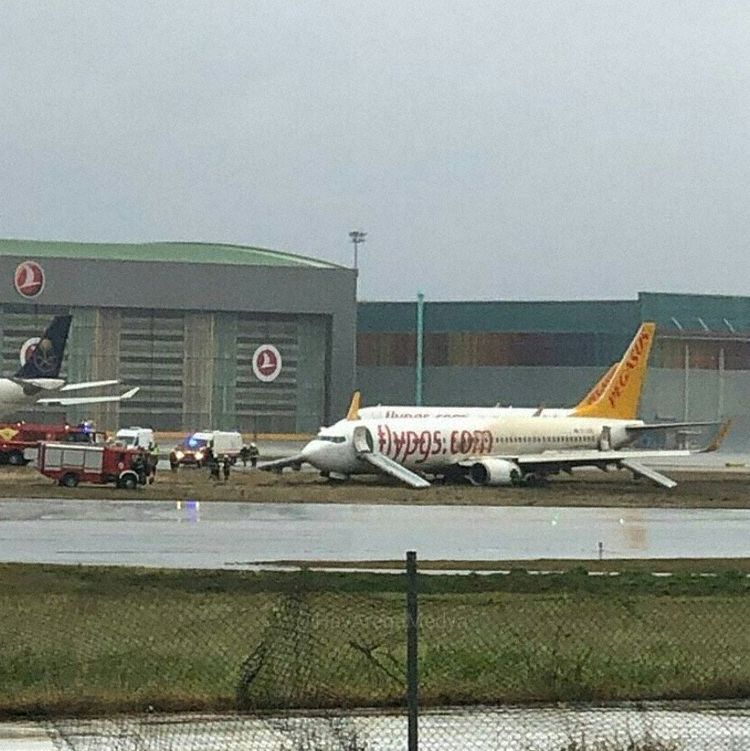
A Pegasus Airlines Boeing 737-800, registration TC-CCK performing flight
PC-747 from Sharjah (United Arab Emirates) to Istanbul Sabiha Gokcen (Turkey) with 164 people on board, landed on Sabiha Gokcen Airport's runway 06 at 09:09L (06:09Z) but shortly after touchdown veered left and came to a stop with all gear on soft ground off the left runway edge about 1000 meters/3330 feet down the runway. The aircraft was evacuated via slides. There were no injuries, the damage to the aircraft is being assessed.
Istanbul's Governor's Office reported the incident occurred due to bad weather. The airport is currently closed, flights are being redirected. The occurrence is being investigated.
The airline reported the aircraft suffered a runway excursion after landing, all occupants disembarked safely. An investigation has begun.
In September 2021 the Turkish Ulasim Emniyeti Inceleme Merkezi (UEIM, Turkish Accident Investigation) created their website and released their first ever final report in Turkish only (Editorial note: to serve the purpose of global prevention of the repeat of causes leading to an occurrence an additional timely release of all occurrence reports in the only world spanning aviation language English would be necessary, a Turkish only release does not achieve this purpose as set by ICAO annex 13 and just forces many aviators to waste much more time and effort each in trying to understand the circumstances leading to the occurrence. Aviators operating internationally are required to read/speak English besides their local language, investigators need to be able to read/write/speak English to communicate with their counterparts all around the globe).
The UEIM concluded the probably causes of the serious incident were:
Human Factors as result of the captain's fault implementation of cross wind landing technique causing a hard touchdown on the runway subsequently steering the aircraft off the runway by applying rudder and ailerons the wrong way with the first officer reacting late.
In addition the report of windshear by previous landing traffic as well as frequent changes of wind direction and intensity are considered contributing factors.
The UEIM listed following main findings:
- pilots were properly licensed and met all regulations, the aircraft met all requirements
- the captain did not apply the proper crosswind landing technique
- a SINK RATE warning occurred twice due to incorrect use of the controls
- the aircraft touched down at +2.605G
- Rudder input was provided to turn the aircraft into the wind instead of counteracting the weathercocking effect
- asymmetric brakes were not used
- the runway excursion is the result of the captain's left rudder application
- the first officer did not intervene
- 24 hours to clear the runway is too long
The UEIM analysed that fatigue was not a factor into the serious incident. Vref had been computed to 142 KIAS, with the wind corrections Vapp was computed at 157 KIAS. According to FDR and CVR data the aircraft performed a stabilized ILS approach to runway 06. At 518 feet AGL the autopilot was disconnected. At 404 feet AGL the airspeed increased to 167 KIAS and reduced to 151 KIAS one second later. Autothrottle gets disconnected at 247 feet AGL, the aircraft is above the glideslope by about half a point, winds at that point 36 knots from 018 degrees, airspeed 169 KIAS. At 197 feet AGL the airspeed is 157 KIAS, winds at 33 knots from 022 degrees.
At 125 feet AGL and 98 feet AGL SINK RATE warnings occurred following large nose down inputs (4 degrees), sink rates above 1000 fpm were recorded between 125 and 57 feet AGL, the aircraft descended 0.6 points below the glideslope and 0.3 points left of the localizer. The aircraft is pitched up by 3 degrees, the airspeed drops to 142 KIAS (15 knots less than required), the aircraft is one dot below the glide and descends at 850 fpm.
The aircraft touched down on the left side of the runway at about 150 KIAS at 681 fpm, engines at 48/44% N1 without being pulled back to idle, the aircraft touched down at +2.605G due to insufficient nose up. The aircraft bounced. With the winds from the left ailerons are applied to the right, but no right rudder is being used to steer the aircraft onto the center line. The aircraft touched down a second time at 6.7 degrees right bank and 3 degrees nose down resulting in +1.6G vertical acceleration. Engines are reduced to idle, full aileron to the right and 5 degrees left rudder are applied, maximum reverse thrust is being applied. Autobrakes engage.
Related NOTAM:
A0101/20 NOTAMN
Q) LTBB/QMRLC/IV/NBO/A /000/999/4054N02919E005
A) LTFJ B) 2001070626 C) 2001070820 EST
E) RWY 06/24 CLSD TO TFC.
Related Flight:
PC747, Twitter:
#PC747,
Pegasus Airlines News