Created Saturday, Jan 7th 2023 20:10Z, last updated Saturday, Jan 7th 2023 20:10Z
A Proflight Zambia de Havilland Dash 8-300, registration 9J-PZB (MSN 405) performing flight
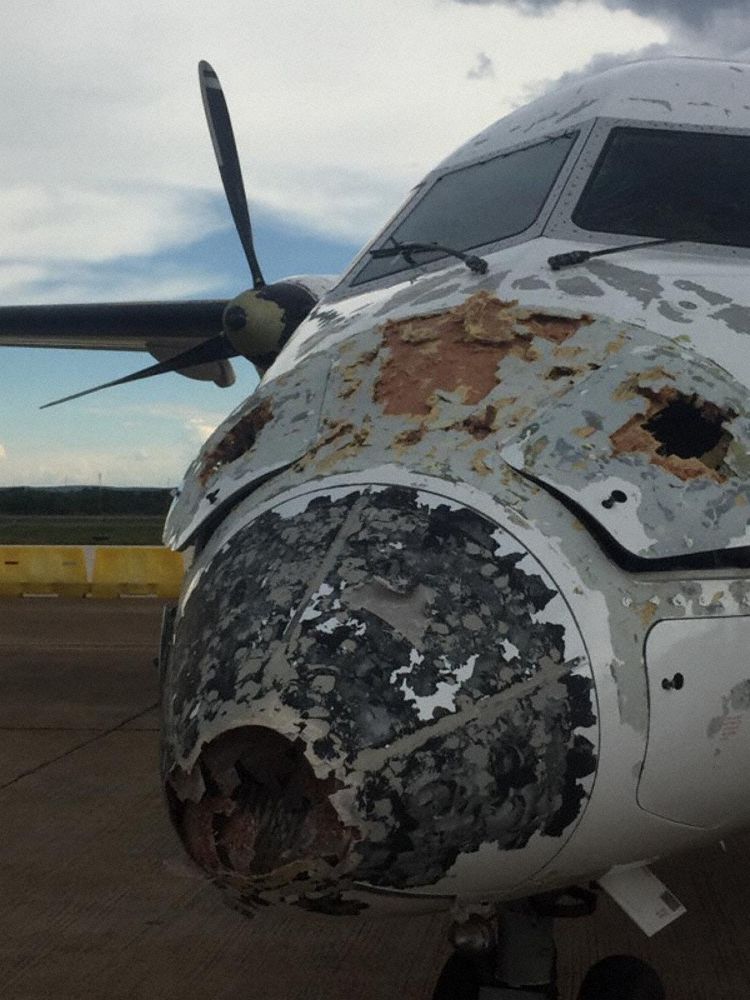
P0-705 from Livingstone to Lusaka (Zambia), was in the initial descent towards Lusaka when the aircraft received lightning and hail strikes and encountered a downdraft and severe turbulence. The aircraft managed to get out of the thunderstorm cell and landed safely in Lusaka at about 13:30L (11:30Z). There were no injuries, the aircraft however received substantial damage possibly beyond repair.
A passenger reported they had just begun their descent towards Lusaka when the aircraft received a lightning strike, then the aircraft "dropped like a stone" with the cabin pressure rapidly changing causing ear pain, the aircraft went through hail. Finally the aircraft left the thunderstorm cell and stabilized again. The aircraft landed safely in Lusaka. On disembarkation the passenger noticed both windshields had cracked, the nose was substantially reshaped, the tail plane and wing roots as well as all leading edges beaten up.
The aircraft had been previously operated by CemAir with the tailnumber ZS-DHF. CemAir temporarily ceased operation in December 2018.
Zambia's AAIB released their final report concluding the probable causes of the accident were:
Cumulonimbus cloud (CB) is associated with extreme weather such as heavy torrential downpours, hail storms and lightning. Due to its size and towering appearance, it is very significant and can be identified from a long distance and is to be avoided at all costs.
The Cumulonimbus storm cell that caused the above mentioned damage to the aircraft should have been identified and avoided from a long distance in the same manner the enroute weather was avoided. Even with the Weather Radar being unserviceable or not performing satisfactorily, a CB is visually identified from a long distance.
The cause(s) of the accident is attributed to:
- Lack of appreciation by the cockpit crew of the Meteorological weather conditions prevailing in spite of the Meteorological aerodrome reports and forecast to the end that, the flight was routed directly into the Cumulonimbus storm rather than away from it.
- Commercial pressure could have contributed due to the 2 hours plus technical delay; the pilots chose a direct route which took the flight into the storm rather than to circumnavigate away from the storm.
- The pilot exhibited lack of good airmanship and judgment by failing to report the encounter of heavy turbulence to Air Traffic Control. This should have been done to contribute to the safety of flights from other aircraft by reporting the time, location and intensity of the encounter.
The AAIB analysed:
The fact that PFZ705 requested to deviate left of track was evident of significant weather activity enroute especially with meteorological information having been given as few Cumulonimbus clouds, broken towering cumulus with base at 3500ft, Scattered ones with base at 10,000ft, Temperature at 29°C with Dew point at 15°C.
A Cumulonimbus cloud is associated with extreme weather such as heavy torrential downpours, hail storms and lightning. Due to its size and towering appearance, it can be identified from a long distance and is to be avoided at all costs.
The extent of the damage to the aircraft could have only come from the impact of a hail storm and lightning only associated with a Cumulonimbus cloud.
The fact that PFZ705 was cleared by Approach Radar to route via ATULI for an ILS approach but chose rather to route directly to LW for a visual approach and then ending up in the middle of a thunderstorm shows that PFZ705 did not have the runway in sight when they requested for a visual approach.
The preceding flight from Lusaka into Livingstone was delayed for about 2 hours causing pressure on the crew to try and catch up with time since, the same Dash 8-Q311 aircraft; registration 9J-PZB was scheduled to undertake a flight into Ndola at 15:30hrs UTC.
The flight PFZ705 did not declare any emergency with Approach Radar Control or Tower.
Related Flight:
P0705, Twitter:
#P0705,
Proflight Air Services News