Created Friday, Apr 29th 2022 18:18Z, last updated Friday, Apr 29th 2022 18:18Z
A Regional Express Americas SAS Avions de Transport Regional ATR-72-212A on behalf of Avianca, registration HK-5041 performing flight
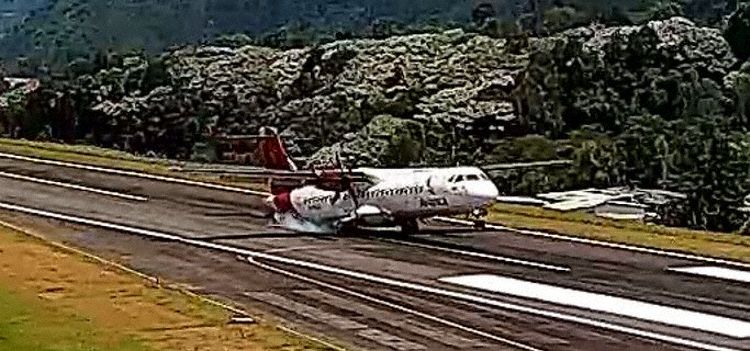
AV-4852 from Bogota to Manizales (Colombia) with 54 passengers and 5 crew, performed a VOR approach to La Nubia Airports's runway 10 with winds reported from 300 degrees at 7 knots and touched down hard (+2.73G) at 600 fpm, the tail contacted the runway surface. A flight attendant received minor injuries as result of the touch down, the aircraft sustained substantial damage.
Colombia's GRIAA released their final report in Spanish only (Editorial note: to serve the purpose of global prevention of the repeat of causes leading to an occurrence an additional timely release of all occurrence reports in the only world spanning aviation language English would be necessary, a Spanish only release does not achieve this purpose as set by ICAO annex 13 and just forces many aviators to waste much more time and effort each in trying to understand the circumstances leading to the occurrence. Aviators operating internationally are required to read/speak English besides their local language, investigators need to be able to read/write/speak English to communicate with their counterparts all around the globe).
The report concludes the probable causes of the accident were:
Abnormal contact with the runway (tail strike during landing)
The crew induced a nose down pitch at about 100 feet AGL coupled with the reduction of engine torque to about 3%, which resulted in a gradual loss of lift and height in the final phase of the approach and a hard touch down.
The crew induced a nose up pitch above 9.4 degrees nose up in response to the loss of height which caused the tail to contact the runway.
Contributing were the tailwind at the time of touch down and the high altitude/low air density which increased speed over ground.
The GRIAA reported the aircraft sustained substantial structural damage as result of the high vertical acceleration and tail strike. A flight attendant received minor injuries at touch down, the jump seat of the flight attendant detached from the floor as result of the tail bumper displacement.
The GRIAA analysed the autopilot, yaw damper and flight director were disengaged at 1200 feet, selected IAS at that point was 105 knots, actual IAS was 110 KIAS, the aircraft descended at 700 fpm, tail wind was 7 knots at that point. The aircraft initiated the turn onto final at 600 feet AGL at 15 degrees bank, the sink rate increased to 1200 fpm then reduced to 300 fpm. The turn was completed at 200 feet AGL below the PAPI indications (3 degrees) at a vertical path of about 2 degrees. However, the GRIAA stated that according to the aircraft manual the stabilized approach criteria were fulfilled. Between 200 and 20 feet AGL the sink rate was between 300 and 700 fpm, at 100 feet AGL a pitch up input occurred to 0.5 degrees nose up, the sink rate reduced. At 60 feet AGL a nose down input was recorded, the pitch angle decreased to -0.5 degrees, the rate of descent increased to 400 fpm further increasing. At 30 feet AGL a large nose up input was recorded, the pitch angle changed from -0.5 degrees to +9.4 degrees, the vertical acceleration increased to 1.5G, the sink rate began to reduce from 700 fpm at 10 feet AGL, the aircraft touched down at 600 fpm and 2.73G on its main wheels at 101 IAS, 128 knots over ground, 9.4 degrees nose up resulting in the tail strike. Following the touch down a vertical acceleration of -0.6G was recorded, the aircraft bounced. Nose down input occurred, the aircraft touched down at second time at -2.1 degrees nose down, on its nose gear, at 100 KIAS (126 knots over ground). The aircraft bounced a second time, a nose up input occurred arresting the pitch at 3 degrees nose up, the aircraft touched down a third time at 96 KIAS and +2.0G at 2.4 degrees nose up on the main gear, opposing control inputs (pilot flying provided nose down input, the pilot monitoring nose up inputs), the aircraft bounced another time and touched down a 4th time at -0.8 degrees pitch and 91 KIAS. Power levers were reduced to idle and into beta, the aircraft now slowed down on reverse.
Possible contributing to the tail strike were the pilot flying's fixation on the Vapp making power adjustments according to the speed trend, nose down pitch inputs below 100 feet AGL and engine power reduction causing the aircraft to sink and the pilot flying's perceiption of this condition followed by the nose up input resulting in the pitch at 9.4 degrees nose up.
The moment the aircraft first touched down (CCTV still image: GRIAA):
Related Flight:
AV4852, Twitter:
#AV4852,
Avianca News