Created Wednesday, May 5th 2021 12:56Z, last updated Wednesday, May 5th 2021 12:56Z
A Republic Airways Embraer ERJ-175, registration N117HQ performing AA-4439 from Atlanta,GA to New York La Guardia,NY (USA) with 6 passengers and 3 crew, was climbing out of Atlanta's runway 09L when the crew declared emergency reporting they had a trim runaway, the crew stopped the climb at about 14,000 feet and positioned for a return to Atlanta's runway 10. The crew subsequently reported, while cleared for a right downwind to runway 10, they were in a stalling situation and subsequently added they couldn't get their pitch down, they were trying to descend nonetheless. ATC offered runway 08L, 10 or 09R, ATC could clear anyone out of the way. The crew advised they were able to take a turn and received vectors to runway 10. Instead of descending the aircraft began to climb again, then descended, the crew advised they got a system warning to cut out, got the problem under control and were now okay, they had been fighting with the aircraft for a while. The aircraft joined the final for runway 10, ATC again offered runway 10 or 09R, "your call", and cleared the aircraft to land either runway. The aircraft landed safely on runway 10 about 19 minutes after departure and about 15 minutes after the emergency call.
The aircraft is still on the ground about 18 hours after landing in Atlanta.
On Dec 6th 2019 the NTSB announced, an investigation was opened into the ocucrrence rated an incident. The NTSB reported the aircraft "experienced a pitch trim anomaly shortly after takeoff from Hartsfield–Jackson Atlanta International Airport (ATL), Atlanta, Georgia. The flight crew declared an emergency and returned to ATL. None of the 9 passengers and crew onboard were injured and the airplane was not damaged."
On Jan 30th 2020 the NTSB released a Safety Recommendation Report stating the sequence of events:
On November 6, 2019, the flight crew of Republic Airways flight 4439, an Embraer EMB-175, declared an emergency shortly after takeoff from ATL with six passengers on board, reporting a pitch trim-related flight control issue and difficulty controlling the airplane. The captain (who was in the left seat and the pilot flying) later reported recognizing the flight control issue after a failed attempt to engage the autopilot about 2,200 ft mean sea level. The captain stated that he conducted the single memory item on Republic’s Pitch Trim Runaway checklist to push and hold the autopilot/trim disconnect button on his side. The captain then asked the first officer to push and hold the right-side autopilot/trim disconnect button. The flight crewmembers reported that they did not notice any change in the pitch condition and continued to have difficulty holding the nose down.
The captain and first officer later reported that they both needed to use both hands to counter the airplane’s nose-up pitch motion and that doing so involved such effort that neither felt that they could reach for the QRH to troubleshoot the problem. Ultimately, the flight crew was able to trim the airplane with the first officer’s trim switch, return to ATL, and land the airplane safely about 15 minutes after declaring the emergency.
Review of data from the incident flight revealed that the airplane was in a mistrim condition for a portion of the flight. While this incident is still under investigation, three areas of concern have been identified: wire chafing, application of Embraer service bulletins (SB) related to the pitch trim switch, and potential limitations in checklist memory item(s) to help Embraer pilots address unintended operation of the pitch trim system.
The NTSB reported that wire chafing was the cause of these trim difficulties stating:
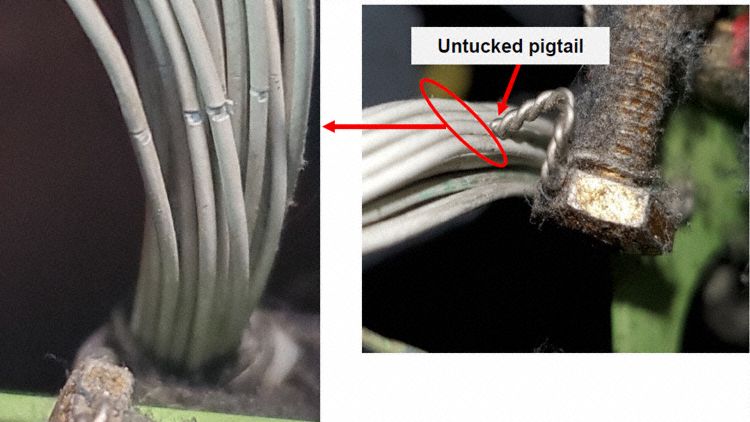
Postincident examination of the airplane (in the area where the captain’s control column runs through the flight deck floor) revealed chafed insulation around the wires connecting the horizontal stabilizer actuator control electronics to the captain’s pitch trim switch and autopilot/trim disconnect button. The chafing damage was caused by contact with the incorrectly untucked pigtail of the forward mechanical stop bolt safety wire.
The maintenance procedures in the EMB-175 airplane maintenance manual (AMM) for adjusting the mechanical stop bolt do not currently draw any specific attention to this critical area.
The NTSB reported such damage was not limited only to the occurrence E175. As result the NTSB released six safety recommendations to Brazil, Embraer and ANAC, and four to the FAA.
On May 5th 2021 the NTSB annoted that their investigators did not travel to the scene of this incident and released their very brief preliminary report stating in its entirety:
On November 6, 2019, about 2115 EST, Republic Airways flight 4439, an Embraer EMB-175, N117HQ, experienced a pitch trim anomaly shortly after takeoff from Hartsfield–Jackson Atlanta International Airport (ATL), Atlanta, Georgia. The flight crew declared an emergency and returned to ATL. None of the 9 passengers and crew onboard were injured and the airplane was not damaged. The airplane was operating under the provisions of Title 14 Code of Federal Regulations Part 121 as regularly scheduled passenger flight and was destined for LaGuardia Airport (LGA), New York, New York.