Created Sunday, Oct 3rd 2021 08:41Z, last updated Tuesday, Jul 5th 2022 19:00Z
A Spirit Airlines Airbus A320-200N, registration N922NK performing flight
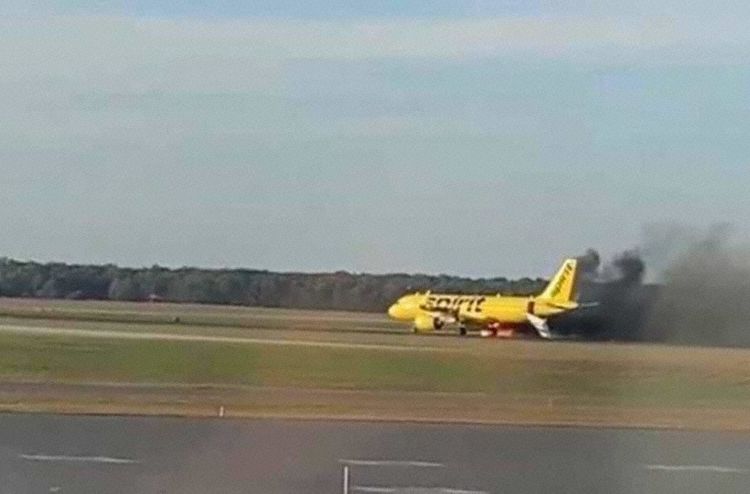
NK-3044 from Atlantic City,NJ to Fort Lauderdale,FL (USA) with 105 passengers and 7 crew, was accelerating for takeoff from Atlantic City's runway 31 when the crew rejected takeoff at low speed (about 60 knots over ground) advising they had a bird strike into the right hand engine (PW1127G) and were stopping on the runway. The aircraft slowed safely and stopped on the runway about 550 meters/1800 feet down the runway, tower queried whether the aircraft needed any assistance, the crew replied "roll the trucks please". A short while later tower advised there appeared to be fire underneath the engine. The crew acknowledged, the fire bell was audible in the background of that transmission, and about a minute later advised they were evacuating the aircraft. 3 passengers and 1 crew travelling as passenger received minor injuries as result of the evacuation.
The airline reported a large bird entered one of the engines, the crew braked safely and brought the aircraft to stop, received indication of engine damage and ordered an evacuation in line with standard operating procedures.
Videos show the aircraft was evacuated through the left hand forward and left hand aft main doors using slides.
On Oct 4th 2021 it emerged, that an entire fan blade had fractured at its root and separated.
On Oct 9th 2021 The Aviation Herald received further (detailed) photos of the engine damage by Bart Dieball.
On Oct 9th 2021 the NTSB reported the right hand engine received a bird strike followed by engine fire. The flight crew reported receiving an engine fire warning, discharged both fire bottles and rejected takeoff at about 90 KIAS and stopped on the runway. The passengers evacuated via slides, 3 passengers and one dead heading crew received minor injuries in the evacuation. The NTSB opened an investigation.
On Jul 5th 2022 the NTSB released their final report concluding the probable cause of the occurrence was:
The ingestion of a bird into the right engine during the takeoff roll caused a fan blade to fracture near the blade platform resulting in high fan blade off loads and engine vibrations sufficient to result in an eventual failure of a fuel tube in the right engine that sprayed fuel onto hot engine cases, igniting an undercowl engine fire and triggering a rejected takeoff.
The NTSB analysed:
Based on the bird remains and feathers collected and identified by Smithsonian Institution National Museum of Nature History Division of Birds - Feather Identification Laboratory, a male immature Blade Eagle was ingested into the right engine striking the fan and causing a single fan blade to fracture near the blade root; the fractured fan blade was contained by the fan case and the remaining fan blades exhibited a combination of leading and trailing edge, as well as blade tip, impact damage, tearing, missing material and bending in the direction opposite rotation. Upon further examination of the engine, it was discovered that two of the thermal management system (TMS) manifold lower aft mounting bracket securing bolts had fractured in shear overstress allowing the bracket to swivel/rotate radially outward. This is one of three mounting brackets that secure the TMS manifold to the engine and prevents excessive moment of the TMS manifold during operation. Along with the broken/sheared TMS lower aft bracket bolts, a crack was visible on the CP-09 fuel line that initiated in fatigue; the CP09 fuel line is attached to the TMS and contains high pressure fuel. The crack in the CP-09 fuel line was due to necking down of the material as the fuel tube bent and stretched (elongated) under the vibration/cyclic loads after the bird strike and not as a manufacturing issue.
The TMS manifold lower aft mounting bracket securing bolts fractured due to the high impact and vibration loads because of the fan blade release after the bird strike. Subsequently the TMS manifold was allowed to move radially back and forward from the engine in response to the engine vibrations that were recorded on the flight data recorder to be in excess of the 10 cockpit units which is the highest value that the flight data recorder will record. The CP-09 fuel line flexed, bent, and stretched under the cyclical radial motion of the TMS manifold until it cracked due to fatigue spraying high pressure fuel onto the hot engine cases igniting an undercowl fire.
An immature male Bald Eagle has a mean mass of about 4,130 grams (g) (9.1 lbs.). The Federal Aviation Administration large bird ingestion certification test bird weight requirement was 2.75 kilograms (6.05 pounds) for the size of the inlet throat area on the PW1127G-JM geared turbofan engine; thus, the incident ingested bird was larger than the certification basis for the engine.
The aircraft seen after stopping but before arrival of emergency services: