Created Thursday, Apr 14th 2022 19:44Z, last updated Thursday, Apr 14th 2022 19:44Z
A Tigerair Taiwan Airbus A320-200, registration B-50001 performing flight
IT-237 from Hakodate (Japan) to Taipei (Taiwan), was enroute at FL300 about 50m northnortheast of Miyazaki (Japan) when the aircraft encountered severe to extreme turbulence causing altitude deviations of +3000 feet (!) and -200 feet, the speed over ground varied between 366 and 266 knots. The aircraft climbed to FL340 shortly after the encounter (which reduced the speed over ground from 366 to 315 knots) and continued to Taipei for a safe landing about 2:15 hours after the turbulence encounter.
Japan's TSB reported the occurrence was rated an accident, an investigation has been opened. One of the flight attendants received serious injuries (fracture of right ankle), another flight attendant and a passenger received minor injuries, when the aircraft suffered turbulence about 50nm from Miyazaki.
On Apr 14th 2022 the JTSB released their final report concluding the probable cause of the accident was:
The JTSB concludes that the aircraft fiercely shook by encountering the wind shear near the jet stream, which caused the cabin crew member who was moving on the aisle in the passenger cabin to fall and sustain serious injury
The JTSB analysed:
(1) Weather conditions
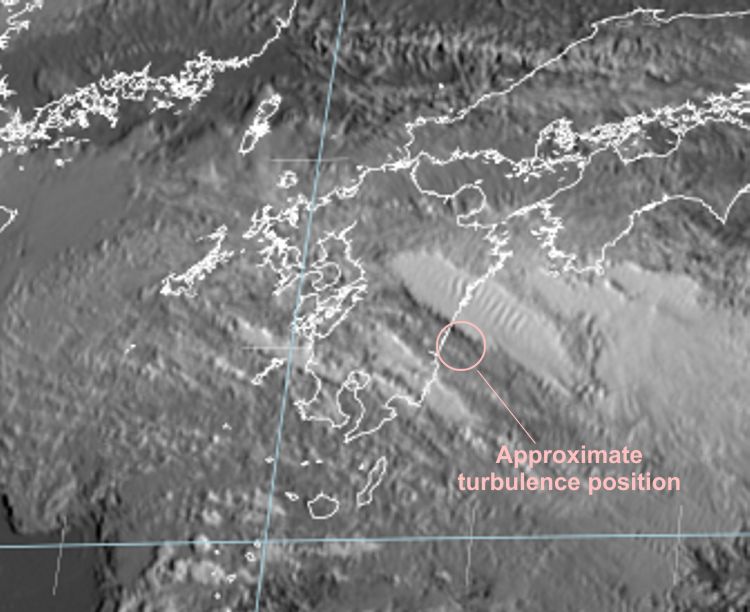
The JTSB concludes that it is highly probable that the severe wind shear existed along the jet stream around the time of the accident occurrence since the transverse line of the high clouds and vertical wind shear area were observed in the vicinity of the accident site. The aircraft is highly probable to have fiercely shaken by encountering the wind shear.
(2) The aircraft shaking
The JTSB concludes, from the record of the FDR, that it is probable that vertical acceleration abruptly fluctuated by encountering the disturbance about 16:12:00, which caused the aircraft to fiercely shake.
The CIC, who was moving on the aisle to return to the Jump Seat in the forward from the aft passenger cabin, is highly probable to have fallen by the fierce shake and sustained the right ankle bone fracture.
(3) Judgment of flight crew
The JTSB concludes that it is probable that flight crew predicted not to encounter such severe turbulence as the one they encountered although they predicted a chance to encounter turbulence from meteorological data confirmed prior to the departure, airborne weather radar display and PIREP.
However, if the flight crew had obtained SIGMET released by the Japan Meteorological Agency at 14:00, it would have been useful for them to make judgements beforehand on changing flight altitude and flight route and the necessity and timing for illuminating seatbelt sign and providing safety information.
(4) Flight operation supporting system of the company
The JTSB concludes that the OCC is probable not to have obtained SIGMET released by the Japan Meteorological Agency at 14:00.
Since SIGMET is the information on significant changes in weather conditions pertaining to safety of the flight, it is probable to be useful to prevent recurrence of similar accidents that the OCC has system in place to obtain SIGMET information in a timely manner and provide it with flight crew as appropriately.
(5) Autopilot disengagement
The JTSB concludes, from the record of the FDR, that the Autopilot is highly probable to have been disengaged at 16:12:03.
It is probable that the FO unintentionally pushed the sidestick forward when the aircraft fiercely shook, and the steering amount exceeding the threshold value (5deg forward) preset for the Autopilot disengagement led to the Autopilot disengagement.
It is probable that the Autopilot disengagement affected subsequent behaviors of the aircraft.
It could not determined whether the bone fracture of the CIC occurred before or after the Autopilot disengagement.
Infrared Image Himawari 8 Dec 25th 2019 07:07Z 6 minutes prior to occurrence (Graphics: AVH/JMA):
Related Flight:
IT237, Twitter:
#IT237,
Tigerair Taiwan News