Created Monday, May 10th 2021 09:55Z, last updated Tuesday, Aug 30th 2022 17:05Z
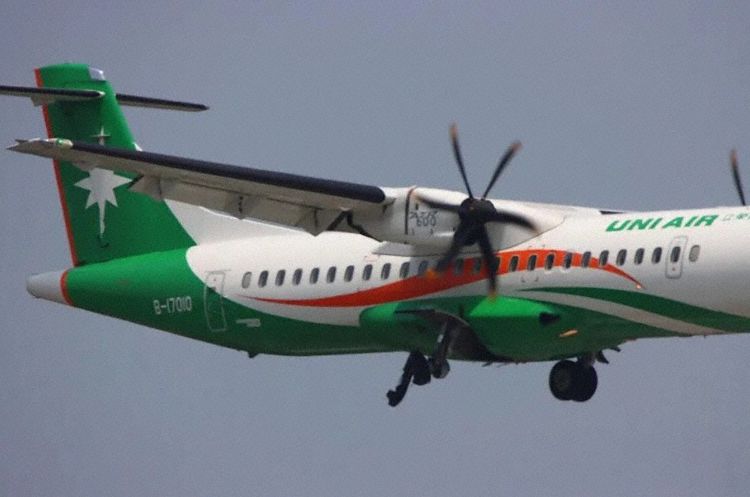
A Uni Air Avions de Transport Regional ATR-72-212A, registration B-17010 performing flight
B7-9091 from Taipei Songshan to Nangan (Taiwan) with 70 passengers and 4 crew, departed Songshan's runway 10, climbed to FL100 and was on short final to Nangan's runway 21 about 40 minutes after departure when both right main tyres were damaged. The crew climbed the aircraft back to FL070, returned to Taipei Songshan, performed a low approach to Songshan's runway 10 about 80 minutes after departure and landed safely back on runway 10 about 100 minutes after departure.
Taiwan's TTSB reported: "On May 10, 2021, at 0927 Taipei time, UNI AIR flight
B7-9091, an ATR72-600 aircraft, departed from Taipei Songshan Airport (RCSS) to Matsu Nangan Airport (RCFG) with two flight crew, two cabin crew, and 70 passengers on board. At 1007 hours, the right landing gear of the aircraft was broken during landing at RCFG, the aircraft go-around and returned back to RCSS Airport. The aircraft landed at RCSS Airport at 1110 hours. The right landing gear of the aircraft was damaged. No injuries to the persons on board." 5 investigators were dispatched to Songshan, subsequently an investigation was opened.
Local Media stated Nangan Airport's Director said, the aircraft was too low on approach, struck a sea wall ahead of the runway causing both right hand main tyres to burst and returned to Songshan.
On May 16th 2021 (local time) a passenger reported they were descending into Nangan, visibility was limited even though the passenger could see the fishing boats at the sea during the descent, the visibility decreased further as they approached the aerodrome, then the engines suddenly revved up and less than a second later an impact could be felt. The nose of the aircraft was pulled up, the aircraft turned left and climbed. The crew announced they were returning to Songshan, immediately thereafter preparations for the emergency landing in Songshan commenced with cabin crew insisting to store everything safely in the lockers or below the seats, take off high heeled shoes, badges or glasses (everything that could hurt).
On May 30th 2022 the TTSB released their final report in Chinese only (an English version can be expected in due time) concluding the probable cause of the accident was (translation by AVH):
When the accident aircraft performed an inaccurate approach to runway 21 of Nangan Airport , there was low cloud or sea fog before the runway threshold. In the final approach stage, the pilot used the autopilot left and right navigation and vertical rate mode to approach. Because he focused on the relevant operations in the cockpit, he lost his awareness of the aircraft position and did not realize that the aircraft altitude was very close to the runway threshold elevation. When the aircraft entered low clouds and the pilot was unable to maintain visual contact with the runway, he did not immediately perform a go-around according to the regulations, and continued to use the autopilot to continue to approach the field. The monitoring pilot did not remind or call for a go-around. The aircraft was at an altitude of 229 feet, about 11 feet above the threshold of the runway, When the pilot decided to go around, but because the height was too low, the main wheels and tail skid hit the top of the outer edge end wall of the head of runway 21 before the aircraft established an effective rate of climb, causing substantial damage to the aircraft.
Related Flight:
B79091, Twitter:
#B79091,
UNI Air News