Created Thursday, Feb 24th 2022 21:40Z, last updated Thursday, Feb 24th 2022 21:40Z
A United Boeing 757-200, registration N26123 performing flight
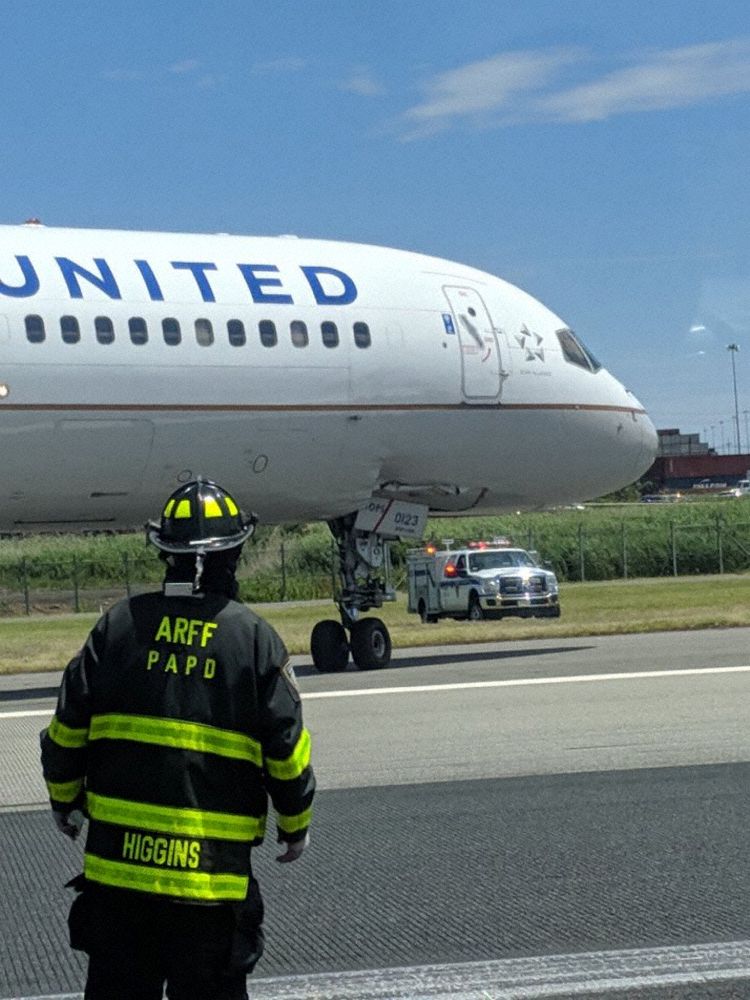
UA-627 from Denver,CO to Newark,NJ (USA) with 166 people on board, landed on Newark's runway 22L at 12:56L (16:56Z) but bounced and touched down hard causing damage to the nose gear and forward fuselage. The aircraft came to a stop with the nose gear off the left runway edge, still on the paved surface of the runway. The passengers disembarked onto the runway via stairs.
A passenger reported the damage is even visible inside the cabin where the nose gear came up into the cabin.
Another passenger reported on Jun 16th 2019 that the aircraft touched down with the left main gear first and bounced, then the aircraft touched down very hard on the nose gear. The aircraft came to a stop with at least two of the four tyres deflated on each left and right main gear. The passenger believes the left hand main tyres deflated on first touch down causing the bounce.
The airline reported the aircraft experienced multiple flat tyres upon landing in Newark. The aircraft became disabled.
The FAA initially reported the aircraft landed on runway 22L and skidded off the left side of the pavement, the left main gear is stuck in a grassy area, later corrected their statement to state preliminary information suggests the left main tyres blew on landing and the aircraft veered to the left side of the pavement.
On Jun 17th 2019 the FAA reported: "HARDLANDING CAUSING BLOWN TIRE AND RUNWAY DEPARTURE", the highest level of injury was minor and the aircraft sustained substantial damage. The occurrence was rated an accident.
On Feb 24th 2022 the NTSB released their final report concluding the probable cause of the accident was:
an improper landing flare, which resulted in a bounced landing and substantial damage.
The NTSB summarized the sequence of events:
The first officer (FO) was the pilot flying, and the captain was pilot monitoring. The takeoff, cruise, and decent were normal. The captain stated that it was an Initial Operating Experience (IOE) flight for the first officer. The auto speed brake system on the airplane was deferred in accordance with the Minimum Equipment List, and had been briefed, and all checklists had been completed. The captain stated that the FO flew a “solid” approach profile with few minor airspeed deviations, all of which were corrected immediately. The crew stated that during the descent to runway 22L the wind became gusty (220 degrees at 14 kts, gusting to 22 kts), and they increased the VREF speed in accordance with company procedures. At 500 feet, the airplane was on profile, on speed and stable. According to the crew the initial touchdown was smooth, on centerline, and in the touchdown zone. Upon touchdown on the main wheels, the captain manually deployed the speed brakes and the nose pitched up. To avoid a tailstrike, the captain said she physically blocked the yoke from moving back and instructed the FO to pitch forward. The airplane then bounced on the runway.
The airplane was equipped with a L-3/Fairchild FA2100 Flight Data Recorder (FDR). FDR data showed that at 12:54:54 EDT, the airplane was on final approach to runway 22L with the autopilot off, glideslope mode engaged, and both flight directors on. At 12:55:14 EDT, with a pitch angle of 2.8 degrees, and the speed brake handle in the down (unarmed) position, the main landing gear (MLG) weight-on-wheels (WOW) parameter changed to GROUND. At 12:55:16 variations in the vertical acceleration, pitch, elevator, and control column parameters increased in magnitude. At 12:55:17, MLG WOW parameter changed back to AIR for one second, then back to GROUND for one second, then back to AIR for one second, before finally cycling back to GROUND. At 12:55:20 the nose gear WOW indicated GROUND for the first time, along with the largest magnitude vertical acceleration of 1.6042 g’s. Both left and right engine thrust reversers indicated deployed six seconds after initial MLG touchdown.
Postaccident inspection of the airplane revealed extensive structural damage to the right and left forward area (41/43 station) of the fuselage. There was extensive damage to twelve skin panels, eleven severed RH stringers and twelve buckled LH stringer sections, multiple underlying damaged structural components, and damage to the nose landing gear and support structure.
Related Flight:
UA627, Twitter:
#UA627,
United Airlines News