Created Thursday, Jul 22nd 2021 17:20Z, last updated Thursday, Jul 22nd 2021 17:20Z
A Westjet de Havilland Dash 8-400, registration C-FKWE performing flight
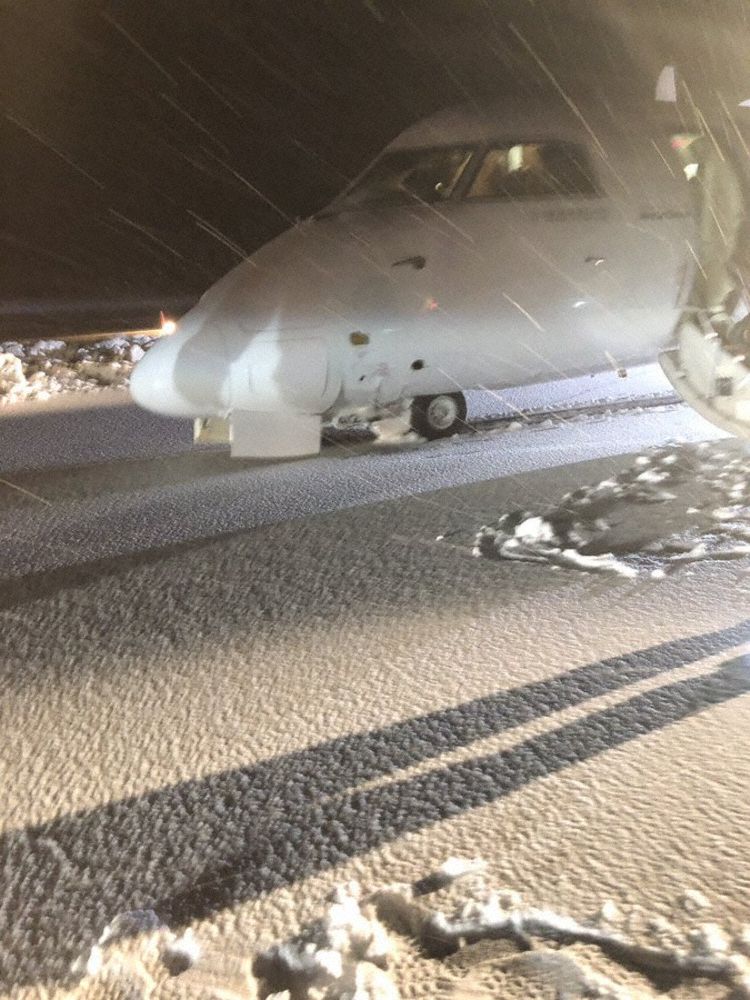
WS-3107 from Vancouver,BC to Terrace,BC (Canada) with 42 passengers and 4 crew, landed on Terrace's runway 33 at 21:06L (Feb 1st 05:06Z) but suffered the collapse of the nose gear and came to a stop on the runway. The passengers disembarked onto the runway and were taken to the terminal.
The airline reported a partial nose gear collapse.
On Mar 17th 2020 the Canadian TSB reported the occurrence was rated an accident, a class 4 investigation was opened. The TSB wrote: "During the landing roll on RWY 33, the aircraft departed the cleared area of the runway to the left, contacted a windrow, travelled partially off the runway surface, returned to the runway and stopped. After the aircraft stopped, the flight crew requested ARFF. There were no injuries. The damage to the aircraft included the nose wheel collapsing and damage to the right propeller blades."
On Jul 22nd 2021 the TSB released their final report concluding the probable causes of the accident were:
Findings as to causes and contributing factors
- Given the falling snow and the snow-covered runway, there were limited visual cues available to the flight crew, which decreased their ability to accurately judge the aircraft’s lateral position once it was beyond the threshold.
- Snow clearing operations cleared the centre 100 feet of the runway, which resulted in windrows that were approximately 18 inches high along the edges of the cleared area. This reduced the pilot’s lateral manoeuvring room during the landing.
- The aircraft initially touched down 10 feet left of the centreline due to control inputs and variable wind conditions and, while the aircraft was still in a light weight-on-wheels condition, a gust contributed to a further deviation to the left until the left main landing gear came into contact with the windrow.
- As the left main landing gear impacted the windrow, the drag on that landing gear caused the aircraft to pull to the left, causing the nose and right main landing gear to also come into contact with the windrow.
- During the runway excursion, snow and ice became packed in the nose landing gear bay and caused structural deformation. Consequently, the nose landing gear was no longer being held in place and collapsed rearward into the fuselage, causing substantial damage to the aircraft.
Findings as to risk
- If aircraft operators do not provide pilots with all the possible tools and relevant information to assess runway suitability for landing, pilots may not evaluate all potential threats and may make decisions based on incomplete or conflicting information.
Other findings
- Based on the aircraft manufacturer’s and operator’s technical examinations, the investigation determined that neither the damage nor the structural repair work performed on the aircraft following the accident on 19 July 2019, contributed to the damage incurred during this occurrence
The TSB analysed:
Both the approach and the landing took place at night on a snow-covered runway, with limited visibility due to snowfall and winds varying in speed and direction.
...
A number of visual cues may be used by pilots to determine their position relative to the runway environment at night. In conditions of poor visibility, there are fewer cues available compared to clear conditions.
At the time of the occurrence, the visibility was estimated at 5/8 statute miles (SM) in light snow, or 3300 feet. When the aircraft reached the decision altitude of 250 feet above ground level (AGL) on the approach, the initial segment of approach lights for Runway 33 was visible and the captain used these lights to line up the aircraft for the approach.
The runway lighting system, which includes runway edge lights, precision approach path indicators (PAPIs), and approach lights, was the main source of lighting available to assess the aircraft’s position relative to the runway environment, maintain the aircraft on the correct glide path, and align the aircraft with the runway.
As the aircraft crossed the threshold, the approach lights were no longer visible in the flight crew’s field of view to help with the alignment of the aircraft along the centreline. The external visual references were limited because snow covered all runway markings and the snowfall obscured the cultural lighting surrounding the runway.
Once over the runway surface, the flight crew had to judge the aircraft’s lateral position based on their assessment of both the degree of asymmetry between the runway edge lights and the symmetrical optical flow provided by the runway edge lights—which were less prominent due to the snowfall—and on the detection of the aircraft’s proximity to the windrows.
Given the continuous snowfall, the snow clearing vehicle operators were not able to keep the full 150-foot width of the runway clear. Instead, they focused on keeping the runway cleared to a width of 100 feet, which is only 2 feet more than the minimum runway width required for the aircraft to land. This resulted in windrows on the runway, which were not cleared before the occurrence aircraft landed. These windrows were not reported to the pilots, nor were they required to be.
Throughout the approach and landing, the crew was dealing with winds that fluctuated between 6 and 12 knots and a wind direction that varied between 40° left and 50° right of the centreline. Although the captain was correcting for drift from the centreline, the variable and unpredictable winds made it difficult to maintain alignment with the centreline.
Before touchdown, the aircraft started drifting to the left. By the time the captain recognized the drift and applied control inputs to correct for it, the aircraft was already touching down.
At this point, the aircraft encountered a 15-knot wind gust from 040° magnetic (M), or 70° off to the right of the centreline.
Due to the short period (2 seconds) between the landing and the impact with the windrow in this occurrence, the flight data available were insufficient for estimating the friction characteristics of the runway.
Related Flight:
WS3107, Twitter:
#WS3107,
WestJet News