Created Sunday, Jan 15th 2023 08:14Z, last updated Thursday, Dec 28th 2023 19:01Z
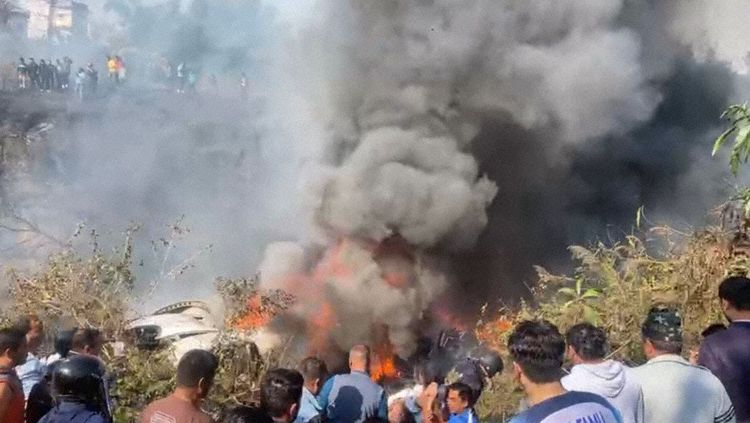
A Yeti Airlines Avions de Transport Regional ATR-72-212A, registration 9N-ANC performing flight YT-691 from Kathmandu to Pokhara (Nepal) with 68 passengers and 4 crew, was on final approach to Pokhara's International Airport's runway 12 when the aircraft stalled, impacted ground between the old Pokhara and the new Pokhara International Airport, fell into a ravine and burst into flames about 1.12nm ahead of the runway threshold at about 11:05L (05:20Z). All 72 occupants perished in the crash.
A Rescue Operation was in progress.
Nepal's CAA (CAAN) reported the aircraft carried 65 passengers and 4 crew, amongst them 53 Nepalis, five Indians, four Russians, four Irish, two Koreans, an Argentinian and a French and published a manifest with the names (Editorial comment: ? this does not add up with 69 people on board). Later the day the CAA corrected their previously corrected version (from 68+4 to 65+4) again to 68 passengers and 4 crew. There were 53 Nepalese, 5 Indian, 4 Russian, 2 Korean, 1 Australian, 1 Argentinian, 1 Irish and 1 French citizen plus the crew on board. 68 bodies were recovered from the crash site.
On Jan 16th 2023 the CAAN reported (correcting their earlier statement) 66 bodies were recovered so far. In the afternoon local Nepal time the CAAN added, that 69 bodies have been recovered, 41 have been identified so far.
On Jan 17th 2023 the CAAN reported that 70 of the 72 bodies have been recovered. 41 bodies have already been identified, 22 have been handed to their families.
On Jan 18th 2023 the CAAN reported that 71 of the 72 bodies have been recovered. The FDR and CVR have been handed to the investigation commission, that is being supported by foreign investigators (BEA, ATR, EASA) who travelled to Pokhara this Wednesday Jan 18th 2023.
On Jan 31st 2023 the Canadian TSB reported they have assigned an accredited representative to participate in the investigation and stated: "The TSB’s accredited representative, along with a technical advisor from Pratt & Whitney Canada, will coordinate the exchange of technical and safety information regarding the engines, which were designed and manufactured in Canada, and assist Nepal with the investigation. The accredited representative will also travel to Singapore to attend the download of the flight recorders, which is set to take place on 28 January 2023."
By Jan 31st 2023 Medical Services report that it is still unclear how many bodies were recovered from the crash site, they have results that may indicate more bodies than known so far have been recovered, only after the DNA analysis is completed there will be certainty. In the meantime Nepal's army using sniffer dogs are still searching for the missing remains.
On Feb 6th 2023 Nepal's AIC reported that both flight data and cockpit voice recorders were successfully read out in Singapore. According to first analysis of the flight data recorders both propellers of the aircraft went into the feather position. The reason for the feathering of both propellers is still being determined, human factors as well as technical factors are still under investigation.
Nepal Rescue Coordination Center (NRCC) in Kathmandu reported 68 bodies were recovered so far. The search for remaining 4 occupants is still on going. The search was interrupted during the night from 15 to 16th January.
On Jan 16th 2023 the NRCC reported the flight data recorder has been recovered from the crash site and been forwarded to the Nepalese army which is going to hand the blackbox over to the investigation team. 35 of the 66 bodies have been identified so far.
On Jan 17th 2023 the NRCC reported both flight data and cockpit voice recorders were recovered (the airline confirms this, however, there is no confirmation from the CAAN yet).
Nepal's government assigned an accident investigation commission. The French BEA is going to participate in the investigation.
On Feb 15th 2023 Nepal's AAIC (Aircraft Accident Investigation Commission) released their preliminary report summarizing the sequence of events:
On 15 January 2023, an ATR 72-212A was operating scheduled flights between Kathmandu (VNKT) and Pokhara International Airport (VNPR). The same flight crew operated two sectors between VNKT to VNPR and VNPR to VNKT earlier in the morning. The accident occurred during a visual approach for runway 12 at VNPR. This was the third flight by the crew members on that day. The flight was operated by two Captains, one Captain was in the process of obtaining aerodrome familarization for operating into Pokhara and the other Captain being the instructor pilot. The Captain being familarized, who was occupying the left hand seat, was the Pilot Flying (PF) and the instructor pilot, occupying the right hand seat, was the Pilot Monitoring (PM).
The take-off, climb, cruise and descent to Pokhara was normal. During the first contact with Pokhara tower the Air Traffic Controller (ATC) assigned the runway 30 to land. But during the later phases of flight crew requested and received clearance from ATC to land on Runway 12.
At 10:51:36, the aircraft descended (from 6,500 feet at five miles away from VNPR and joined the downwind track for Runway 12 to the north of the runway. The aircraft was visually identified by ATC during the approach. At 10:56:12, the pilots extended the flaps to the 15 degrees position and selected the landing gears lever to the down position. The take-off (TO) setting was selected on power management panel.
At 10:56:27, the PF disengaged the Autopilot System (AP) at an altitude of 721 feet Above Ground Level (AGL). The PF then called for “FLAPS 30” at 10:56:32, and the PM replied, “Flaps 30 and descending”. The flight data recorder (FDR) data did not record any flap surface movement at that time. Instead, the propeller rotation speed (Np) of both engines decreased simultaneously to less than 25%1 and the torque (Tq) started decreasing to 0%, which is consistent with both propellers going into the feathered condition. On the cockpit voice recorder (CVR) area microphone recording, a single Master Caution chime was recorded at 10:56:36. The flight crew then carried out the “Before Landing Checklist” before starting the left turn onto the base leg. During that time, the power lever angle increased from 41% to 44%. At the point, Np of both propellers were recorded as Non-Computed Data (NCD) in the FDR and the torque (Tq) of both engines were at 0%. When propellers are in feather, they are not producing thrust.
When both propellers were feathered, the investigation team observed that both engines of 9N-ANC were running flight idle condition during the event flight to prevent over torque. As per the FDR data, all the recorded parameters related to engines did not show any anomaly. At 10:56:50 when the radio altitude callout for five hundred feet3 was annunciated, another “click” sound was heard. The aircraft reached a maximum bank angle of 30 degrees at this altitude. The recorded Np and Tq data remained invalid. The yaw damper disconnected four seconds later. The PF consulted the PM on whether to continue the left turn and the PM replied to continue the turn. Subsequently, the PF asked the PM on whether to continue descend and the PM responded it was not necessary and instructed to apply a little power. At 10:56:54, another click was heard, followed by the flaps surface movement to the 30 degrees position.
When ATC gave the clearance for landing at 10:57:07, the PF mentioned twice that there was no power coming from the engines. At 10:57:11, the power levers were advanced first to 62 degrees then to the maximum power position. It was followed by a “click” sound at 10:57:16. One second after the “click” sound, the aircraft was at the initiation of its last turn at 368 feet AGL, the highpressure turbine speed (Nh) of both engines increased from 73% to 77%.
It is noted that the PF handed over control of the aircraft to the PM at 10:57:18. At 10:57:20, the PM (who was previously the PF) repeated again that there was no power from the engines. At 10:57:24 when the aircraft was at 311 feet AGL, the stick shaker was activated warning the crew that the aircraft Angle of Attack (AoA) increased up to the stick shaker threshold.
At 10:57:26, a second sequence of stick shaker warning was activated when the aircraft banked towards the left abruptly. Thereafter, the radio altitude alert for two hundred feet was annunciated, and the cricket sound and stick shaker ceased. At 10:57:32, sound of impact was heard in the CVR. The FDR and CVR stopped recording at 10:57:33 and 10:57:35 respectively.
Pokhara's new International Airport was opened on Jan 1st 2023 to replace the old domestic Airport.
The position of the crash site according to the preliminary report: N28.1975 E83.985
On Dec 28th 2023 the AAIC released their final report concluding the probable causes of the crash were:
The most probable cause of the accident is determined to be the inadvertent movement of both condition levers to the feathered position in flight, which resulted in feathering of both propellers and subsequent loss of thrust, leading to an aerodynamic stall and collision with terrain.
The contributing factors to the accident are:
- High workload due to operating into a new airport with surrounding terrain and the crew missing the associated flight deck and engine indications that both propellers had been feathered.
- Human factor issues such as high workload and stress that appears to have resulted in the misidentification and selection of the propellers to the feathered position.
- The proximity of terrain requiring a tight circuit to land on runway 12. This tight circuit was not the usual visual circuit pattern and contributed to the high workload. This tight pattern also meant that the approach did not meet the stabilised visual approach criteria.
- Use of visual approach circuit for RWY 12 without any evaluation, validation and resolution of its threats which were highlighted by the SRM team of CAAN and advices proposed in flight procedures design report conducted by the consultant and without the development and approval of the chart by the operator and regulator respectively.
- Lack of appropriate technical and skill based training (including simulator) to the crew and proper classroom briefings (for that flight) for the safe operation of flight at new airport for visual approach to runway 12.
- Non-compliance with SOPs, ineffective CRM and lack of sterile cockpit discipline.
The AAIC reported the left hand seat was occupied by a Captain (45, ATPL, 6,396 hours total, 186 hours on type) to be familiared and was pilot flying, the right hand seat was occupied by an instructor (59, ATPL, 21,901 hours total, 3,300 hours on type) who assumed the role of pilot monitoring.
The AAIC summarized the decisive sequence of events:
At 10:56:27, the PF disengaged the Autopilot System (AP) at an altitude of 721 feet Above Ground Level (AGL). The PF then called for “FLAPS 30” at 10:56:32, and the PM replied, “Flaps 30 and continue descent. The flight data recorder (FDR) data did not record any flap surface movement at that time. Instead, the propeller rotation speed (Np) of both engines decreased simultaneously to less than 25% and the torque (Tq) started decreasing to 0%, which is consistent with both propellers going into the feathered condition. The feather condition is not recorded in the FDR parameters. On the cockpit voice recorder (CVR) area microphone recording, a single Master Caution chime was recorded at 10:56:36. As per CVR readout, the flight crew then carried out the “Before Landing Checklist” without identifying the flaps were not to the 300 position, before starting the left turn onto the base leg. During that time, the power lever angle increased from 41% to 44%. At that point, Np of both propellers was recorded as Non-Computed Data (NCD) in the FDR and the torque (Tq) of both engines was at 0%. When propellers are in feather, they are not producing thrust.
When both propellers were feathered both engines of 9N-ANC were running in flight idle condition during the event flight as per design to prevent overtorque. As per the FDR data, the engine turbo machine were functioning as expected considering the propeller were feathered. At 10:56:50 when the radio altitude callout for five hundred feet was annunciated, another “click” sound was heard. The aircraft turned to the left and reached a maximum bank angle of 30 degrees. The recorded Np and Tq data remained non-computed, in line with propellers being in feather condition. The yaw damper was disconnected four seconds later. The PF consulted the PM on whether to continue the left turn and the PM replied to continue the turn. Subsequently, the PF asked the PM on whether to continue descend and the PM responded it was not necessary and instructed to apply a little power. At 10:56:54, another click was heard, followed by the flaps moving to the 30 degrees position.
When ATC gave the clearance for landing at 10:57:07, the crew did not respond to the tower, the PF mentioned twice that there was no power coming from the engines. The FDR data shows that at 10:57:11, the power levers were advanced first to 62 degrees then to the maximum power position in 2 seconds. It was followed by a “click” sound at 10:57:16. One second after the “click” sound, the aircraft was at the initiation of its last left turn at 368 feet AGL, the highpressure turbine speed (Nh) of both engines increased from 73% to 77%.
It is noted that at 10:57:18, in the very last stage of flight, the PF handed over control of the aircraft to the PM. At 10:57:20, the PM (who was previously the PF) repeated again that there was no power from the engines. At 10:57:24 when the aircraft was at 311 feet AGL, the stick shaker was activated warning the crew that the aircraft Angle of Attack (AoA) increased up to the stick shaker threshold.
At 10:57:26, a second sequence of stick shaker warning was activated when the aircraft banked towards the left abruptly. Three seconds later, the radio altitude alert for two hundred feet was annunciated, and the cricket sound and stick shaker ceased. At 10:57:32, sound of impact was heard in the CVR. The FDR and CVR stopped recording at 10:57:33 and 10:57:35 respectively.
The AAIC analysed:
During the course of the investigation, in particular, the analysis of the flight recorder data, the recorded parameters indicated that the propellers were most likely moved to the feathered condition when the PF requested for Flaps 30 during the approach. The condition levers and flap lever are located next to each other on the pedestal and closer to the co-pilot seat.
The FDR only recorded 187 parameters of which the position of the condition levers were not recorded. It was through the detailed examination of aircraft components from the wreckage that provided corroborating evidence for the flight recorder data as follows:
- The witness marking from the propeller hub indicated that the propeller were close to the feathered angle.
- The right hand MFC super advance BITE records did not indicate any auto feather command from the RH AFU.
The witness marks from the pedestal indicates that the left condition lever was in the feathered position. Although the right hand condition lever did not have witness marks it is probable that the lever was also in the feathered position based on the FDR data and MFC examination corroboration.
All evidence gathered from the detailed examinations appear to indicate that the propellers were manually selected to the feathered position.
...
There was no evidence of engine failure in FDR data analysis until the impact of the aircraft. Both the engines were running at idle condition till the time of impact. Hence the possibility of engine failure is ruled out. There was no evidence of any systems failure either. Hence, the failure of the aircraft systems e.g. hydraulic, flight control and other major components can, too, be ruled out. The probability that the power-plants, systems, or structural failures or any other mechanical malfunction contributing to the accident can be ruled out. The Commission examined the maintenance history of the aircraft and found that all the airworthiness directives and service bulletins had been complied with as per the maintenance requirements within the prescribed time frame. The technical logs and log books show that the maintenance works, major inspection works and modifications were carried out as per the approved maintenance program and bulletins. No technical defect was found in the technical logbook prior to the flight. On the basis of available evidences, any technical or mechanical reason has been discounted.
...
Detailed examinations of the pedestal showed:
- The flap lever was locked in the 30° position, with damage to the lever consistent with the application of a high force from the rear during the accident. As a result, the lever was clearly in the 30° position at impact.
- Traces and impact on the Condition Lever 1 rail are consistent with a FEATHER position at impact (no other impact on other position on the rail of Condition lever 1);
- No trace on the Condition Lever 2;
- Traces and damage on Power levers 1 and 2 are consistent with a position forward (zone corresponding to high power).
- The Gust Lock lever was moved rearward upon impact during the accident sequence and deformed. The lever was therefore forward before impact (normal position in flight).
...
The departure from KTM was normal.
Before reaching MANKA, the PM expressed intentions to familiarize PF on RWY 12 if traffic permits and briefed on the visual approach procedure for RWY 12 emphasizing the need of a sharp turn during final approach. The intent for runway change was to clear PF from RWY12 under IP supervision. However, this familiarization from RWY12 was not planned by the operator‟s operations department.
When the aircraft was at 15 miles to PHR, 6500ft, the PM requested and received clearance for landing on RWY 12. After receiving approval for RWY12, the PM briefed the PF on manoeuvring techniques, the circuit, heading and radial to be followed as well as the altitude to be maintained. After joining downwind, RWY12, the crew announced flap 15. The PM continued briefings on visual landmarks, obstacle, runway orientation etc. The crew then announced flap 30. However, it was found the checklist in all phases of flight was not carried out appropriately as per SOP.
PF voiced concerns about ELEC lights but CVR records do not show any response from PM.
The PF then asked if they should continue the turn to which the PM responded “positive”.
Subsequently, PM advised on increasing the power, but PF reported that there was no power and PF once again repeated that there was no power, no torque. The FDR records show the power levers were moved from flight idle position to RAMP position.
The PM who was occupying right hand seat had made 2 landings at RWY 12; one from left hand seat and the other from right hand seat. The flight was first for PF who was occupying left hand seat. Previous experience, type of flight and seating position, etc. might have affected the situational awareness in the critical phase of the flight.
From the retrieved FDR data, flight path of the event flight as well as another flight on 12th Jan, 2023 where other set of crews landed on RWY 12 were recovered.
The flight trajectories show that the flight path gradients were not as per ATR 72-212A version 500‟s flight manual. Due to the tight circuit and shortened final leg of RWY 12, the stabilization criteria for visual approach couldn‟t be maintained at the height of 500 ft. AGL. Sequence of events of the accident flight resembled previous flights of the day to Pokhara, except for when
Ground observer video:
The crash site:
Map (Graphics: AVH/Google Earth):